News Desk
For centuries, the treacherous waters of the Vaadhoo Channel separated Malé and Vilimalé. Close enough to see across on a clear day, the channel’s rough swells routinely turned the short trip into a harsh reminder of the sea’s barrier.
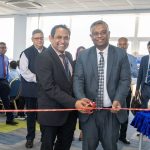
On Sunday afternoon, President Dr Mohamed Muizzu crossed that historic divide on foot, walking the newly connected superstructure of the Thilamalé Bridge before meeting reporters in Vilimalé.
The President started his walk from Malé at around 5:15 p.m., accompanied by High Commissioner of India to the Maldives G. Balasubramanian, Cabinet Ministers, heads of state-owned enterprises, and local journalists who walked the marine crossing alongside the official delegation.
Speaking to reporters upon arriving in Vilimalé, President Muizzu took full credit for materializing key infrastructure projects—in particular the Thilamalé Bridge and the Hanimaadhoo Airport expansion—despite both initiatives having been initiated and funded under the previous MDP administration.
The MVR 7.7 billion (USD 500 million) Greater Malé Connectivity Project spans 6.74 kilometres of bridges, viaducts, and causeways linking Malé, Vilimalé, Gulhifalhu, and Thilafushi. Financed through an MVR 1.54 billion (USD 100 million) grant from India and an MVR 6.16 billion (USD 400 million) line of credit from Exim Bank of India, the project was launched under former President Ibrahim Mohamed Solih.
To clear logistical delays, President Muizzu’s administration set up a high-level joint committee with India, accelerating progress on both the bridge and the Hanimaadhoo Airport expansion. Overall physical work on the bridge complex now stands at 77 percent, up from 27 percent when the current administration took office in late 2023.
Engineering credit for mastering the unforgiving marine channel goes to Indian contractor Afcons Infrastructure. Renowned for tackling severe engineering feats worldwide, the firm has built a massive global presence spanning over 30 countries across South Asia, the Middle East, Africa, and Europe.
The company’s portfolio is defined by its ability to execute projects in environments that actively resist construction:
- Maldives Infrastructure: Navigating unpredictable oceanic currents, Afcons executed deep marine piling in water that offered no guarantees. The project required installing 264 piles across 68 locations and placing 1,222 bridge-deck segments, including a single marine pile reaching a depth of 120 metres—among the deepest ever driven in the world.
- Undersea Tunnelling: In Kolkata, Afcons bored India’s first underwater metro beneath the Hooghly River. In Mumbai, they expanded on this expertise by constructing an undersea tunnel beneath the Arabian Sea to connect Mumbai to Navi Mumbai through one of the world’s most congested maritime corridors.
- Chenab Railway Bridge: Serving as the lead contractor in a joint venture consortium, Afcons constructed the world’s highest single-arch railway bridge over Jammu and Kashmir’s Chenab River.
- Atal Tunnel: The firm successfully engineered a passage through the notorious Seri Nala fault zone—a 526-metre stretch where relentless water ingress repeatedly collapsed the tunnel face into mudslides and boulders. Overcoming this four-year obstacle ultimately established year-round access for the isolated Lahaul-Spiti region.
- Cross-Border Developments: Beyond India and the Maldives, Afcons built the vital Second Bhairab Railway Bridge in Bangladesh, constructed the New Sulphur Jetty in Kuwait and the Phosphate Rock Terminal in Jordan, and developed Dubai’s Jewel of the Creek waterfront.
- European Expansion: Marking its formal entry into the European market, the company recently secured a €677 million railway modernisation contract in Croatia.
Whether boring beneath riverbeds, anchoring steel arches high above canyon floors, or driving deep foundations through treacherous island channels, Afcons has built its reputation on adapting to terrain where nature rarely cooperates.
While the superstructure connecting Malé to Vilimalé is now fully joined, final asphalt work, safety barriers, and lighting installation remain before opening to regular traffic, with full project completion targeted within the next year.
President Muizzu expressed gratitude to the Indian government, the Indian High Commissioner, Minister of Construction and Infrastructure Dr Abdulla Muththalib, and Afcons for pushing the project toward completion, calling the bridge a lasting symbol of close bilateral ties between the Maldives and India.