News Desk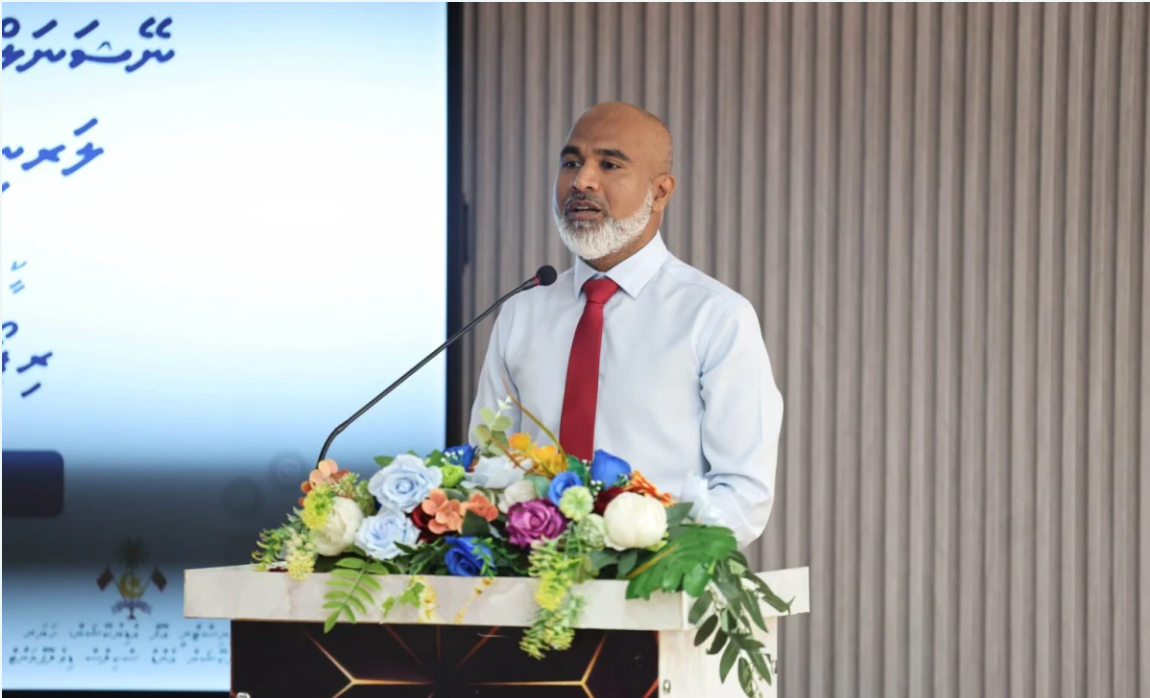
The Education Minister made headlines this week by revealing that more than 8,000 students have been absent from school since the World Cup began, with 40 percent of those absences concentrated in the Male’ region. He called it a matter of significant concern. He said parents and teachers need to reflect. He announced a monitoring platform.
What he did not say, and what the number itself does not tell us, is that this is not a new problem. The World Cup did not create 8,000 absent students. It revealed them. Any senior member of the ministry’s own team could have told him this. The attendance crisis predates the tournament by years. The minister simply had not been looking or had not been asking. When the World Cup gave him a convenient explanation, he reached for it. But the children who are staying home were staying home before Lionel Messi kicked a ball, and they will stay home after the final whistle.
The World Cup is not the cause. It is the occasion that finally made the number visible enough to mention at a ceremony. So if 8,000 children are choosing to stay home, the question worth asking is why school is not reason enough to come.
That is not a question about discipline. It is a question about what school has become, and what it is failing to be.
The Environment We Are Not Talking About
Start at home, because that is where the child starts. In Male’, a family of four or five might share 600 square feet divided into three small bedroom cubicles. The television is on. Adult conversations fill the air. Visiting relatives from the islands arrive and dispense their judgements on the children passing through the room. There is no quiet. There is no space. There is very little that resembles an environment in which a child can rest, think or feel settled.
Then the child goes to school and finds that the pressure does not lift.
Parents who spoke to eTruth described a school environment that can feel as charged as the home. Aisha, a mother in Male’, said the social judgement that runs through Maldivian society has seeped into the classroom. If a girl is not wearing a head cover, she is noticed. She is categorised. She carries that weight into a place that is supposed to be about learning.
Maryam described something harder to say out loud. Bullying, she said, is not only done by students to other students. Teachers do it too. She named specifically the Islamic studies and Quran teachers in her child’s school. She said children who do not conform to a particular expression of religiosity are made to feel it.
A child who feels judged at home, judged at school and judged in the community is not going to be enthusiastic about attendance. She is going to take any available exit. Right now, the World Cup is providing one.
The Classroom as a Closed Room
There is a particular kind of failure that happens when a child arrives at school genuinely curious and is made to feel that curiosity is dangerous.
A child asks who created the world. It is one of the most natural questions a human being can ask. In a well-trained classroom, that question opens a conversation about faith, philosophy and the limits of human knowledge. In too many Maldivian classrooms, that question is met with a reprimand. The child learns not that the answer is complicated, but that asking is wrong. She does not ask again. She retreats.
Teachers are not trained for this. That is not an accusation. It is a structural failure. The questions children bring to school in 2026, shaped by the internet, by social media, by exposure to a global conversation that the Maldives is fully part of whether it chooses to be or not, are questions that require a different kind of teacher preparation than what most currently receive. A child who has spent the previous evening watching YouTube and reading comment sections arrives in class the next morning with questions that a curriculum designed for a different era is not equipped to handle.
The Digital Preacher Problem
Go to Facebook. Read the comment sections under any post touching on religion, gender, relationships or mental health. What you find is a portrait of a society’s psychological state, compressed into a few lines of text. What you also find is an army of online preachers, most of them untrained, all of them confident, dispensing guidance that is often beyond the intellectual or emotional reach of the people asking for it.
A young woman posts a question about something she cannot quite name, an unease that sits just beneath the surface, a restlessness that no amount of doing the right things seems to quiet. She mentions that she prays five times a day including the optional late-night prayer. She is struggling. The answer she receives is: pray more. When she explains that prayer is not the issue, that she is already doing everything she was told to do and still feels lost, the online preacher has nothing left. The script has run out.
This is not a small problem. The information age has produced a generation of young Maldivians who are asking real questions about identity, meaning, faith and belonging, and finding that neither the school system nor the digital religious establishment has the tools to engage with those questions honestly. The result is not a rejection of belief. It is disengagement. And disengagement from school is one of its mildest symptoms.
The Parenting Gap
No one trains for parenthood. This is true everywhere, but in the Maldives it carries particular weight given the divorce rate, the housing conditions and the pace of social change over the past two decades. Benjamin Spock spent his career arguing that parents instinctively know more than they think they do, but that they also need support, information and the confidence to trust their own judgement. The Maldives has not built that support system in any meaningful way.
Parenting classes do not exist at scale. Counselling is still treated with suspicion in many communities. The idea that being a parent is a skill that can be developed, rather than a role that simply happens to you, has not entered mainstream Maldivian culture. Meanwhile the children are growing up in conditions of considerable pressure, navigating the expectations of home, school, religion and an internet that has no off switch.
What the Number Actually Tells Us
The minister should not be congratulated for discovering that 8,000 children are missing school. He should be asked what the government’s education policy has done, over the two years this administration has been in office, to make school a place that children want to be. That is a harder question than building a monitoring platform.
The 8,000 are not missing school because of the World Cup. The World Cup is simply the occasion. They are missing school because, for a significant number of them, school is not offering enough to compete with the alternatives. That is an indictment not of the children, and not entirely of the parents, but of a system that has prioritised metrics over meaning for long enough that the children themselves have noticed.
Every day a student misses is a day that negatively impacts learning. The minister is right about that. But every day a student sits in a classroom feeling judged, silenced or unseen is also a day that negatively impacts learning. The monitoring platform will count the absences. It will not count the damage done inside the building to the children who showed up.
That is the harder number. And it does not make headlines.