News Desk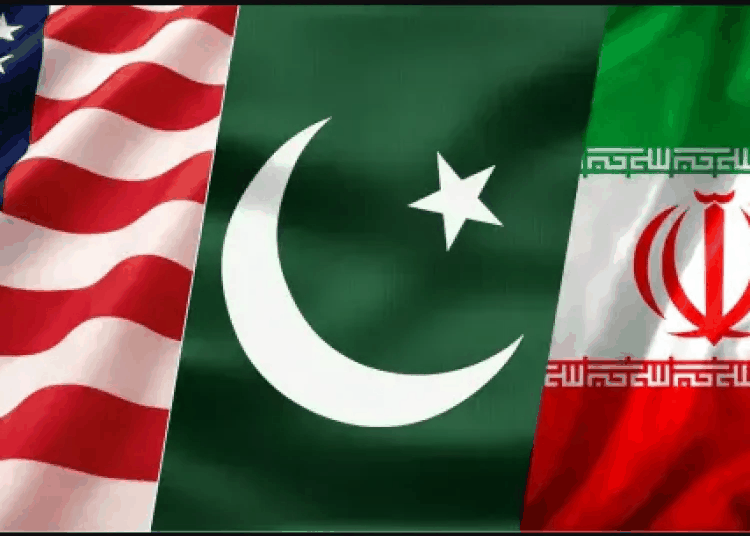
Pakistan’s attempt to position itself as a mediator in the ongoing United States-Iran engagement has highlighted a persistent and structural weakness in its diplomatic profile, namely a lack of credibility as a neutral interlocutor. The visit of Pakistan’s Army Chief, General Asim Munir, to Muscat to seek Omani support for reviving stalled talks shows that Islamabad has been unable to sustain confidence among the principal stakeholders. The failure to convene the second round of talks in Islamabad reflects more than logistical disruption. The early departure of the Iranian Foreign Minister, followed by Washington’s decision to suspend the visit of its envoys, indicates a breakdown rooted in trust rather than timing. Diplomatic mediation requires consistency, discretion, and neutrality. Pakistan’s conduct appears to have raised doubts on all three counts.
Iran’s concerns have become increasingly explicit because it does not view Pakistan as a reliable or neutral intermediary. There are indications that Iran suspects Islamabad of conveying inconsistent or inaccurate messages between the two sides. Moreover there is apprehension that sensitive details from confidential exchanges may have been shared with the United States. Such actions, if perceived to be true, directly undermine the fundamental requirement of confidentiality in mediation processes. These developments have had immediate consequences. Iran has demonstrated a clear preference for Oman as the venue for further engagement. Oman’s diplomatic approach has historically been defined by quiet facilitation, strategic neutrality, and balanced relations with both Washington and Tehran. This stands in contrast to Pakistan’s position, which is shaped by visible strategic dependencies and fluctuating alignments.
Beyond concerns of confidentiality, there is also a broader strategic suspicion influencing Iran’s assessment. Sections within the Iranian establishment appear to believe that the Pakistan track may be serving as a cover for the United States to recalibrate its military posture in the region. In this interpretation, prolonged and inconclusive talks provide Washington with operational space while Iran remains engaged in a controlled diplomatic process. Pakistan, by enabling such a framework, is viewed as contributing to a managed distraction rather than a genuine resolution effort. Skepticism regarding Pakistan’s role is not limited to Iran as Israel has also expressed reservations about Islamabad’s credibility as a mediator. While Israel is not directly involved in the negotiations, its assessment reflects a wider perception within the strategic community that Pakistan lacks the consistency and transparency required for such a role. In contrast, countries like Oman and Qatar have established themselves as dependable facilitators through sustained and disciplined diplomatic engagement.
Pakistan reportedly underwent extensive security preparations and disruptions in anticipation of high level engagements that ultimately did not materialize. This has led to public inconvenience and internal dissatisfaction, further amplifying the perception of diplomatic mismanagement. When one negotiating party does not trust the host and the other engages only conditionally, the resulting optics weaken the host’s standing. Pakistan’s challenge extends beyond this specific episode. It reflects a deeper issue in its approach to international mediation. Effective intermediaries maintain strategic equidistance, ensure strict confidentiality, and build long term trust with all parties involved. Pakistan’s track record, influenced by its security partnerships and geopolitical positioning, complicates its ability to project such neutrality.
In the past, Pakistan has sought to leverage its geographic and political position to play intermediary roles in regional affairs. However, such ambitions require sustained credibility, which cannot be asserted but must be demonstrated over time. Unlike Oman, which has consistently maintained a balanced regional posture, or Qatar, which has invested in discreet facilitation roles, Pakistan’s engagements are often perceived through the lens of competing strategic interests. The growing preference for Oman in the current context reflects a pragmatic shift by both the United States and Iran. For both parties, the effectiveness of the process outweighs considerations of symbolic inclusion. A mediator must be trusted by all sides, not merely accepted. Oman’s ability to provide a stable and neutral platform has therefore become more relevant than Pakistan’s attempts to assert a role.
Contrary to what Pakistan wishes to portray as a peace mediator, the recent Pakistani attacks on the east Afghan province of Kunar marks the first major cross border attack since recent peace talks aimed at de-escalating the ongoing 2026 Afghanistan Pakistan conflict, raising serious questions about Islamabad’s commitment to stability in its immediate neighbourhood. At a time when Pakistan seeks to project itself as a mediator in the US Iran engagement, it remains actively involved in a conflict with a neighbouring state, where the primary victims continue to be innocent civilians. This contradiction weakens its claim to neutrality and reinforces concerns about its suitability as a credible intermediary. A state engaged in active hostilities, while simultaneously attempting to facilitate dialogue elsewhere, struggles to inspire confidence among parties that require assurance of impartiality, restraint, and diplomatic consistency.
The image of Pakistan’s military leadership seeking facilitation support from Oman highlights reality. It signals a transition from an aspirational mediator to a peripheral actor dependent on more credible intermediaries. This shift reflects not a temporary setback but a structural limitation in Pakistan’s current diplomatic positioning. As the US Iran engagement continues to evolve, the center of gravity is likely to remain with actors that command trust and maintain discretion unlike Pakistan.