News Desk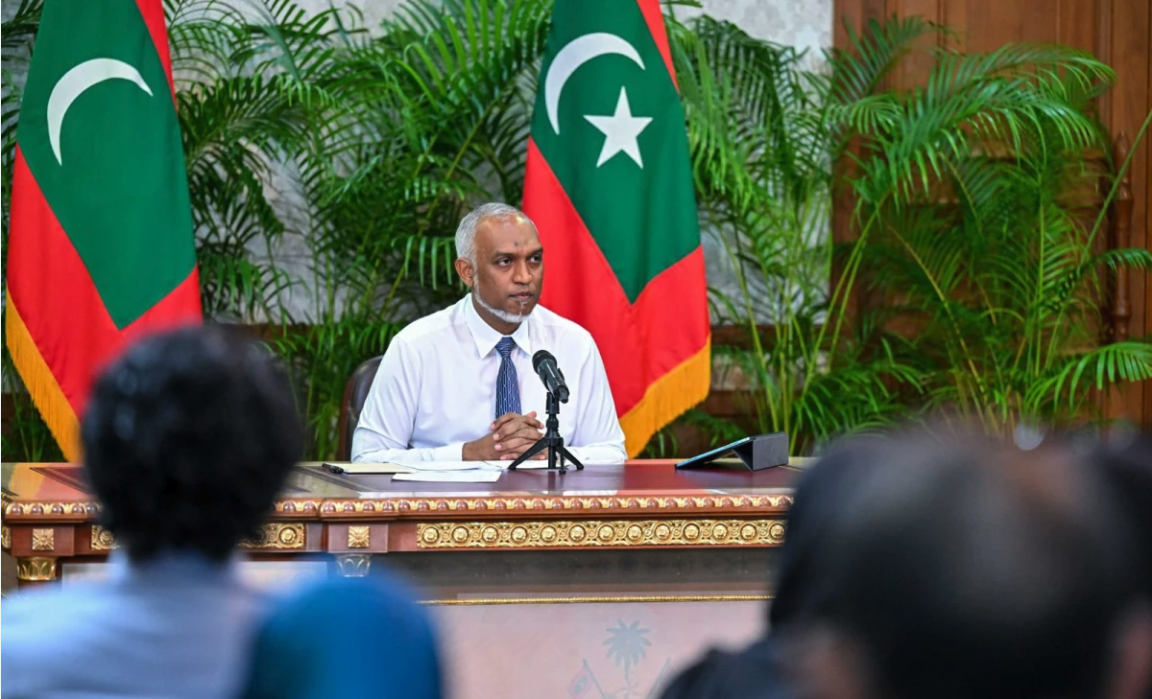
President Dr Mohamed Muizzu held a press conference at the President’s Office on Monday, attended by journalists from 17 outlets and broadcast live on all television channels. The session produced a series campaign promises and announcements that will reshape key state institutions, public services and economic policy. It was also notable for a detail that sharp-eyed viewers noticed before a word was spoken.
The Table That Witnessed History
Before the announcements, there was the desk. The desk where the president had his press conference was a piece of furniture that witnessed the democratic history of the country.
The desk has been used by every president since Maumoon Abdul Gayoom. Nasheed signed off on the introduction of GST and Aasandha at it. Waheed took the decision to expel GMR from the airport project and navigated political crisis from behind it. Yameen approved the big infrastructure projects of his era there. Solih managed a pandemic from it. And Muizzu now sits behind it. The table was recently in the news, and the clarification given by the PO was that the talk of the town is not the mighty table, but some other table that was infested by termites… Is the President’s Office having termites?
The desk had been reported sold at auction weeks earlier, prompting criticism. The President’s Office said that report was false and that the auctioned item was a different, termite-damaged piece of furniture that had been altered in photographs to look like the presidential desk. On Monday, the real desk was back in the frame, and what was announced at it carried considerable weight.
Nationalising Dhiraagu and MWSC
The most significant economic announcement was the government’s decision to reclaim majority control of Dhiraagu and full ownership of MWSC.
The government currently holds 41.8 percent of Dhiraagu. The majority 52 percent stake is owned by Bahrain’s Batelco, with the public holding 6.2 percent. Muizzu said the cabinet has decided to bring the government’s share to 51 percent, effectively renationalising the telecoms company.
“Dhiraagu’s shares were sold off by the first MDP government when the government held the majority. That was a very significant public asset,” Muizzu said. “We believe bringing the share back to 51 percent is essential for the people’s welfare and for the economy.”
MWSC currently has 20 percent foreign ownership, held by Japan’s Hitachi, a stake also sold during the Nasheed administration. Muizzu said the government has now decided to buy back that stake and make MWSC fully state-owned.
Details of the transactions will be announced by the Finance Ministry.
Dissolving Fenaka and RDCI: Streamlining State Companies
In a move that will affect thousands of employees, Muizzu announced that Fenaka Corporation, which provides water, sewerage and electricity to islands across the country, will be dissolved and its functions transferred to Stelco.
He said the Auditor General’s reports had exposed serious problems at Fenaka under the previous government, and that technical experts had advised it could not be run sustainably in its current form. The Anti-Corruption Commission currently has 161 active investigations related to Fenaka, and has already ordered the recovery of MVR 21.4 million. Fenaka’s former managing director was convicted and jailed. The corporation employs over 8,000 people.
“After deep consideration and consultation, the government has decided to dissolve Fenaka and merge it with Stelco. Once that process is complete, Stelco will provide services across the entire country,” Muizzu said.
Separately, the Road Development Corporation, established six years ago to build and maintain roads across inhabited islands, will also be dissolved. Its work will be transferred to MTCC.
“RDCI does road construction. MTCC also does road construction and infrastructure work. There is a lot of duplication and a lot of cost. We are making this change to deliver infrastructure projects through an efficient system,” Muizzu said.
Agro National Corporation, known as AgroNet, will become a subsidiary of MIFCO, combining fisheries and agriculture under one structure. The new Male’ market is expected to be completed by December next year under MIFCO’s management.
Aasandha Reform: The Wealthy Will Now Pay
From next month, Maldivians earning more than MVR 60,000 a month will no longer receive full Aasandha coverage free of charge.
Muizzu said the current system, which provides identical coverage to the wealthiest and the poorest citizens alike, is not equitable. Under the new arrangement, those above the income threshold will access Aasandha through a co-pay or pre-pay model, contributing an annual fee.
“The wealthy and those who pay income tax do not need to receive everything free the way it is available to ordinary citizens,” Muizzu said. “This change will come into effect next month.”
He said the reform will save MVR 287 million annually from the state budget.
The government has previously made other cuts to Aasandha spending, driven by the scheme’s persistent cost overruns.
Resort Shares for Every Maldivian
Muizzu said the locations for ten government-developed resorts will be finalised this week, with construction expected to begin in November.
The plan, announced in February’s presidential address to Majlis, would make every Maldivian a shareholder in the resorts. Once operational, each citizen would receive at least $400 a year from resort profits, with the target start date being 2030. For a family of five, that would mean at least $2,000 annually.
“The result will be that every single Maldivian becomes a resort shareholder, and once these resorts open, dollars will be deposited into each person’s account,” Muizzu said.
Judiciary Reform: Small Claims Court and Commercial Court
Muizzu said the government intends to submit amendments to civil procedure laws in the new parliamentary session beginning in October, targeting the chronic backlog in Maldivian courts.
A small claims court will be established to handle civil cases under MVR 100,000 quickly and simply. The government is also studying whether to establish a commercial unit within the Civil Court or a separate Mercantile Court to handle business disputes more efficiently. An idea that was under consideration during Yameen is back on the table.
“Cases under 100,000 rufiyaa could be filed and resolved quickly, something like a fast-track system,” Muizzu said.
He said the government has already moved to stop political interference in courts, granted the judiciary financial independence through a block grant budget, and provided new premises to address space constraints at the Criminal Court and Drug Court. Work on a Superior Court complex has also begun.
Addu Link Road: Work to Begin Within the Month
Muizzu acknowledged that the Addu City link road upgrade project has been significantly delayed, blaming the poor capacity of RDCI, which was meant to execute the work.
He said equipment has been procured and transported to Addu, and that proposals from foreign contractors are now being processed.
“Within this month, the link road work will begin at speed,” Muizzu said.
Islamization Policy: Dhikr Boards Across Every Island
Muizzu announced that a nationwide programme to install Islamic remembrance and advice boards in the main streets and public areas of every inhabited island will be launched on 13 September, timed to coincide with the 900th anniversary of the Maldives’ conversion to Islam.
The programme, which Muizzu originally piloted during his time as Male’ City Mayor. The nationwide version will run for one year, funded jointly by the government, civil society organisations and members of the public.
“On 13 September we will launch a one-year programme, God willing, to place dhikr and islamic advice boards in every public area and main road on every island in the country,” Muizzu said.
The same date will see the groundbreaking ceremony for the country’s largest mosque, to be built in Hulhumale’.
National Respect Programme
Muizzu said opposition parties refused invitations to participate in the planning of his National Respect Programme, a five-year initiative to revive Islamic values of courtesy and mutual respect in Maldivian society, which was approved by cabinet on Sunday.
“We deeply regret this. We invited all parties. This is everyone’s cause. Respect in society is something everyone should want. But no opposition party participated. They refused. That is not responsible behaviour,” Muizzu said.
He called on all parties to put national interest above political opposition, saying that blocking every government initiative regardless of its merit was not a principled position.