News Desk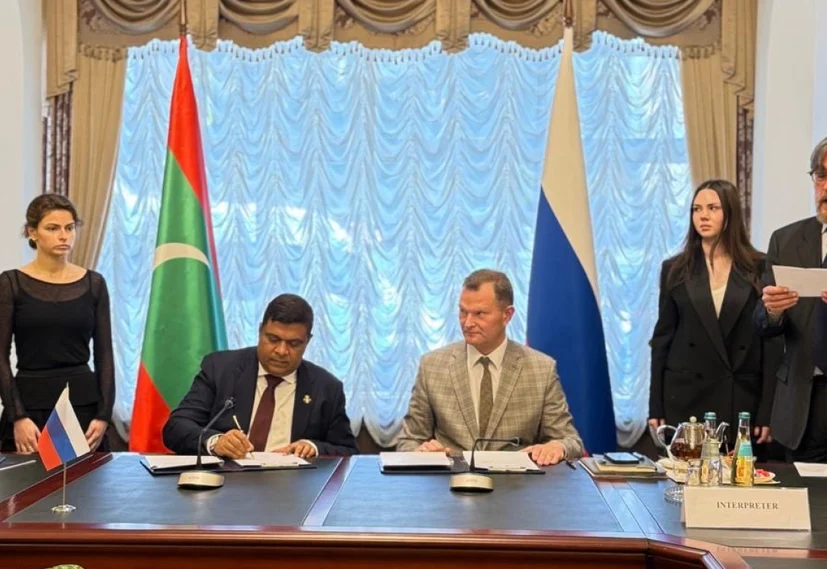
When the People’s Majlis passed amendments last month requiring foreign travel agents and tour operators to register with MIRA and pay tourism goods and services tax directly to the Maldivian state, it passed with 54 votes in favour and almost no public debate about how, practically, this would work for agents operating in sanctioned markets.
Mohamed Firaaq, founder and chief executive of Inner Maldives Holidays, one of the country’s better-known travel agencies, put the question that the vote did not answer.
“How exactly are Russian agents supposed to pay 17 percent TGST directly to MIRA?” he wrote publicly. “Bank transfer? From where? Through which channel? With which compliance clearance? Maldives welcomed 253,834 Russian tourists in 2025, our second-largest source market by arrivals and arguably one of the biggest revenue markets by spend. Many already struggle to pay resorts normally. Some payments move through Dubai, cash channels or crypto because of sanctions and banking restrictions. So are we expecting them to register with MIRA, file returns, and send TGST by suitcase?”
Nobody has answered him.
The question matters because Russian travellers are not simply numerous. They are, by most industry accounts, among the highest-spending visitors the Maldives receives. They book longer stays, choose ultra-luxury private island properties, and spend heavily on high-margin services. Losing them, or even significantly complicating their ability to book, would be felt in revenue terms well beyond what arrival numbers suggest.
The problem is structural. Since 2022, major Russian financial institutions have been disconnected from the SWIFT network as part of Western sanctions imposed following the military operation in Ukraine. Money from Russian travel agents reaches Maldivian resorts through workarounds: intermediary financial entities in Dubai or Turkey, cryptocurrency transfers, cash settled at check-in. These channels function for resort payments because resorts have the flexibility to accept them quietly. MIRA does not have that flexibility.
If a Russian agent in Moscow attempts to wire TGST directly to MIRA through normal foreign exchange channels, correspondent banks in Western financial systems are likely to halt or freeze the transfer under sanctions protocols. MIRA, for its part, cannot accept transfers through informal or unverified channels without risking its standing with international monetary bodies.
The result is a compliance mechanism that cannot actually be complied with by a significant portion of the market it is meant to capture.
Firaaq’s position is not that Russian agents should not pay tax. It is that the government has created a legal obligation without providing the financial infrastructure to fulfil it. Agents facing that situation have three options: find a workaround that may itself carry legal risk, divert their clients to destinations with more flexible booking and payment infrastructure, or do nothing and wait for enforcement that may never come.
Thailand, Dubai and Türkiye have all invested in payment systems that accommodate sanctioned market flows. The Maldives has not, and the new TGST framework does not acknowledge the gap.
MIRA has not publicly addressed the Russian payment problem. The Russian Embassy in Colombo, which has diplomatic oversight for the Maldives, has not issued guidance to Russian operators. The Tourism Ministry has not commented.
The amendment was projected to bring in MVR 16 billion in additional annual revenue. How much of that projection accounts for the portion of the market that cannot currently wire money to a government account is unclear.
The suitcase, as Firaaq noted, remains an option. It is not, however, a tax policy.
On August 17, 2026, the Maldives and Russia agreed to expand direct flights and facilitate additional carriers following bilateral talks in Moscow between Maldivian Tourism and Civil Aviation Minister Mohamed Ameen and Russian Transport Secretary Dmitry Zverev. Russia remains the Maldives’ second-largest tourist source market, generating nearly 200,000 visitors.
Despite ongoing geopolitical sanctions and airspace restrictions affecting Russian travel elsewhere, the Maldives remains one of the few long-haul beach destinations maintaining uninterrupted, expanding direct air links with Moscow.