News Desk
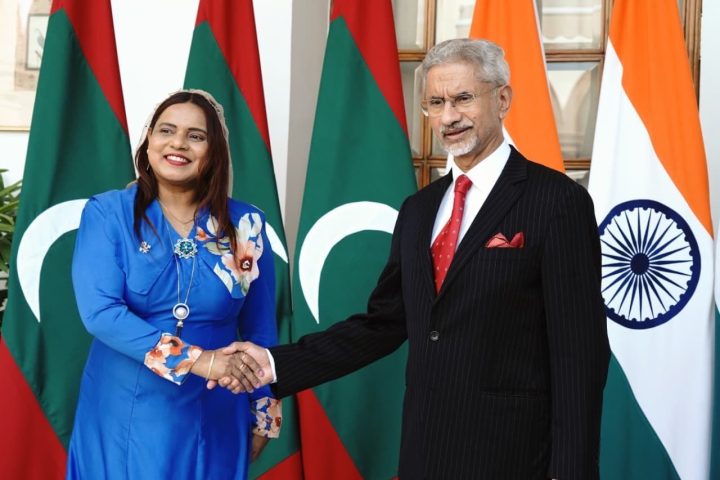
India emerges as the third most positively viewed country in a new Maldives-wide survey conducted by the Barney Centre for International Policy, with the findings revealing a clear generational divide in how Maldivians perceive major powers. India’s overall score places it third among the most favourably regarded nations, though support is significantly stronger among older Maldivians. Younger respondents expressed noticeably cooler attitudes, marking one of the widest generational splits in the survey.
Saudi Arabia and China top the list of most positively viewed foreign countries. Both received the highest average scores among all nations included in the study, and—unlike India—their support levels were consistent across age groups, according to the researchers.
The survey was carried out by telephone between 23 November and 1 December last year, involving 391 voting‑age Maldivians. The organisation noted that this exceeds the sample size required for a 95 per cent confidence level with a five per cent margin of error, making the results statistically robust.
Views of the United States showed the strongest age-based divergence. Respondents over 55 gave the US a markedly higher score, while young adults aged 18 to 24 rated it at 3.5, the lowest among Western countries surveyed.
Younger Maldivians’ higher ratings for both Russia and a range of Western countries point to a generational realignment in how global powers are perceived, with the contrast to older respondents revealing where attitudes are shifting most clearly. Russia’s score of 5.2, the highest among the countries listed, suggests that younger Maldivians view Moscow with a degree of openness not shared by older generations. This may reflect several factors: Russia’s assertive global posture, its visibility in international media, and a perception among younger people that it represents an alternative to traditional Western influence. The fact that Russia outperforms all Western countries in this age group indicates that its image is not shaped by Cold War‑era narratives that still resonate with older Maldivians.
Australia (4.9) and the United Kingdom (4.3) remain relatively well regarded, showing that Western democracies continue to hold appeal among the youth. These scores suggest that younger Maldivians are not turning away from the West; rather, they are diversifying their geopolitical preferences. Ukraine (3.9) and the United States (3.5) sit lower on the scale, reflecting more cautious or mixed views—particularly towards Washington, where the generational divide is most pronounced.
Taken together, the data show that younger Maldivians are less anchored to traditional Western alignments than older generations. They appear more comfortable evaluating countries individually rather than through a West‑versus‑rest lens. Russia’s strong performance, combined with respectable scores for Australia and the UK, suggests that the youth are forming a more pluralistic worldview—one shaped by global media, multipolar politics, and a sense of distance from older geopolitical loyalties.