News Desk
MALE’ — Before the Bureau for Public Complaints holds its first press conference, opens its 24-hour call centre or routes its first AI-assisted grievance to a government agency, here is a suggestion: do the research first.
Find out where the complaints actually come from. Which agency generates the most grievances. Which department has the longest unresolved backlog. Which minister’s office sends back the most form-letter responses that say nothing while appearing to say something. Publish that data. Set a time limit, say 14 days, for a grievance to receive a substantive response, not an acknowledgement, not a forwarded reply from the agency being complained about, but an actual answer. And then publish whether those deadlines are being met.
That would be a complaints bureau. What the Maldives has seen before is a complaints inbox.
It is not as if the Maldives has never tried.
Maldivians have always found a way to complain to the president. Under Maumoon Abdul Gayoom, who governed for thirty years, citizens wrote letters. Long, handwritten letters about land disputes, unpaid wages, files opened against them by authorities, cases that had gone nowhere for years. The presidency was the last stop when every other door had closed. Some letters were answered. Some were not. But the impulse, the belief that somewhere at the top someone might listen, never went away.
That tradition has now been formalised. The government has appointed Mahid Shareef as Principal Secretary of the newly established Bureau for Public Complaints, a dedicated office that will receive, process and respond to grievances submitted by citizens against the state.
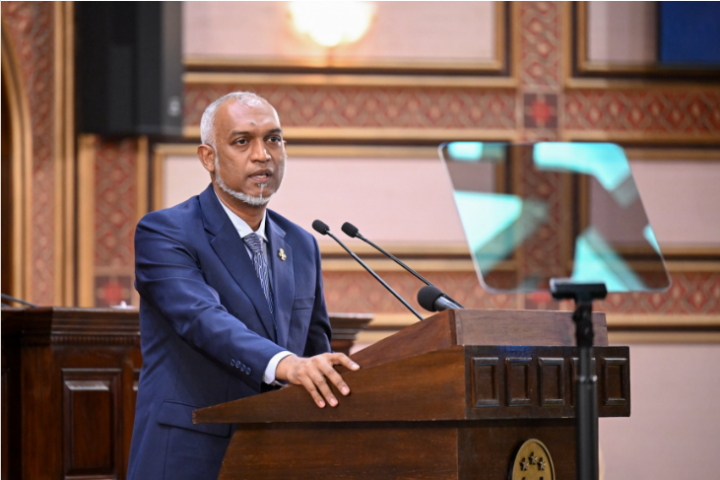
President Dr Mohamed Muizzu announced the bureau in his presidential address on 5 February. The office was established last month. A formal launch of services is expected soon. Mahid was appointed at ministerial level on Monday.
Mahid brings serious credentials to the role. He holds a PhD in Business Administration and has served as a Permanent Secretary and Deputy Vice-Chancellor of the Islamic University of the Maldives. Until his appointment, he was CEO of the Institute of Chartered Accountants of the Maldives.
The bureau will operate around the clock. A 24-hour call centre will be set up alongside digital submission platforms. Complaints received through various channels will be managed through an AI-assisted system designed to route grievances to the relevant agency, obtain information and provide a response. The President’s Office said speed of response is a central objective.
That last part is where the scepticism begins. The previous model, informal as it was, followed a familiar pattern: a citizen submitted a grievance, the relevant state agency was asked about it, the agency wrote back defending itself, and that reply was repackaged and forwarded to the citizen as a response. The complaint remained unresolved. The agency remained unaccountable. The citizen was told, in effect, that the people they were complaining about had looked into it and found nothing wrong.
A digital system with AI routing does not fix that problem unless the bureau has the independence and the authority to push back on the agencies it is supposed to be holding to account.
In practice, a citizen filing a complaint is complaining about someone the President appointed, to another person the President appointed. That is not a structural guarantee of impartiality. It is a loop. Whether Mahid Shareef has the mandate and the spine to break that loop is the only thing that will determine whether this bureau means anything at all.
The Maldives has no ombudsman. It never has. That absence has left citizens with limited formal recourse when the state acts against them, whether through a legitimate grievance or through the kind of file-opening that has historically been used to control rather than serve. In a small country where the line between genuine investigation and political management of individuals has often been blurred, a bureau that sits inside the President’s Office raises as many questions as it answers.
Whether this becomes a genuine channel for accountability or a managed inbox where complaints are acknowledged and quietly shelved will depend entirely on the person running it and the mandate he is given. Mahid is qualified. The architecture sounds functional. But institutions in the Maldives have a long history of being well-designed on paper and politically constrained in practice.
The citizens will write. Or call. Or submit the digital form. They always have. The question, as it has always been, is whether anyone on the other end is truly listening.