News Desk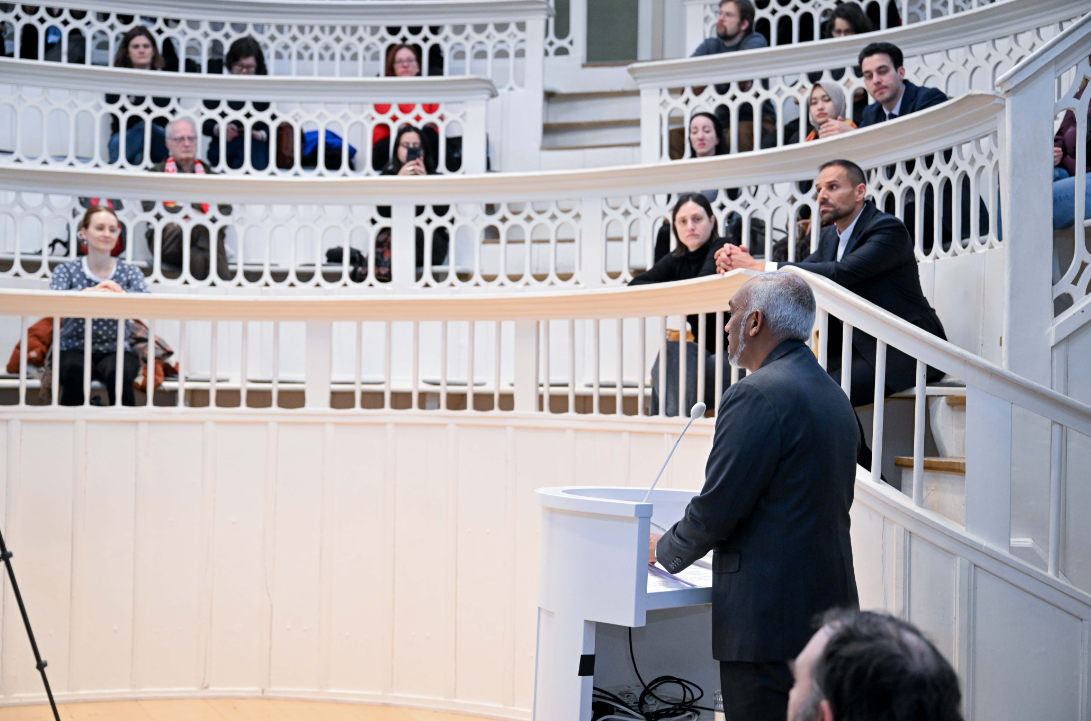
Berlin, — Speaking at Humboldt University, President Dr Mohamed Muizzu delivered a stark warning that climate change has already surpassed the limits of national sovereignty and political cycles, urging governments to confront what he called “a crisis of inequality” that threatens the world’s most vulnerable nations first.
Addressing academics, researchers and students at one of Europe’s most respected universities, President Muizzu framed the Maldives as both a frontline witness and a test case for the international system’s ability to respond to accelerating climate risks.
“There isn’t a more fitting place to discuss climate change without borders,” he said, praising Humboldt’s tradition of scholarship that serves society and transcends national boundaries.
The President described the Maldives as a country where climate change is not a theoretical concern but a lived reality. “For us, climate change is not a distant abstraction. It is a daily reality, causing irreversible damage,” he said.
Despite contributing only 0.003 per cent of global greenhouse gas emissions, the Maldives faces some of the world’s most acute climate threats. With more than 1,200 coral islands and an average elevation of 1.5 metres above sea level, the nation’s geography leaves it exposed to rising seas and intensifying storms.
“The ocean has always been our provider,” he said. “But today, that same ocean poses our greatest risk.”
President Muizzu stressed that adaptation is no longer a policy choice for his country. “Adaptation for us is not an option. It is a matter of continuity, of nationhood, culture and identity.”
He outlined a national strategy that includes coastal protection, land elevation, disaster‑preparedness systems and ecosystem restoration. But he argued that adaptation must be understood as a governance challenge rather than a purely technical one.
“How do you plan for risks that will unfold over decades, when political cycles last a few years?” he asked. “How do you make decisions today that will affect generations yet unborn?”
The Maldives, he said, has begun integrating climate risk into national planning and budgeting, strengthening local government capacity and coordinating finance to deliver adaptation at scale.
The President highlighted Hulhumalé, an elevated island city, as a model of climate‑resilient development. He also announced progress on Ras‑Malé, set to become the largest manmade island ever developed in the Maldives.
“Designed above projected sea‑level rise, Ras‑Malé reflects our resolve to build safely and sustainably,” he said, describing it as a holistic urban plan incorporating housing, schools, hospitals, energy systems and coastal protection.
President Muizzu argued that climate change has exposed deep structural inequities in the global system. “Those who contributed the least are paying the highest price,” he said. “Adaptation financing is not charity. It is climate justice and it is an obligation.”
He called for predictable and concessional climate finance to allow vulnerable nations to adapt without replicating the environmentally damaging development pathways of the past.
The Maldives, he said, offers lessons for the world: the importance of early action, people‑centred resilience, nature‑based solutions and the integration of climate considerations into all aspects of development.
The President emphasised the responsibility of academic institutions in shaping global climate responses. “You generate the knowledge that informs policy,” he told the audience. He urged universities to break down disciplinary silos, strengthen the bridge between science and policymaking and amplify voices from vulnerable regions.
“Climate change without borders requires knowledge without borders,” he said.
Anticipating scepticism about the influence of small island states, President Muizzu argued that vulnerability offers a clarity that powerful nations often lack. “From the frontlines of climate change, we see the consequences of inaction with painful clarity,” he said.
He described the Maldives as a test of multilateralism and global solidarity. “If we fail this test, the consequences will not stop with us.”
In closing, the President urged governments to act before catastrophe forces their hand. “Climate change without borders demands solutions without borders,” he said. “Let future generations say this was the moment when the world chose cooperation over division, responsibility over denial, and resilience over resignation.”
President Muizzu’s address at Humboldt University formed part of his official visit to Germany, aimed at strengthening cooperation on climate research, renewable energy and higher education partnerships. During the visit, President Muizzu signalled a deliberate shift in Maldivian foreign policy, broadening the country’s diplomatic and economic partnerships and positioning himself as a more vocal participant within the international community rather than a peripheral member. He held meetings with senior German officials, business leaders, academic institutions and climate scientists, underscoring his government’s intention to diversify external engagement and deepen collaboration on climate resilience, renewable energy and technological innovation.