News Desk
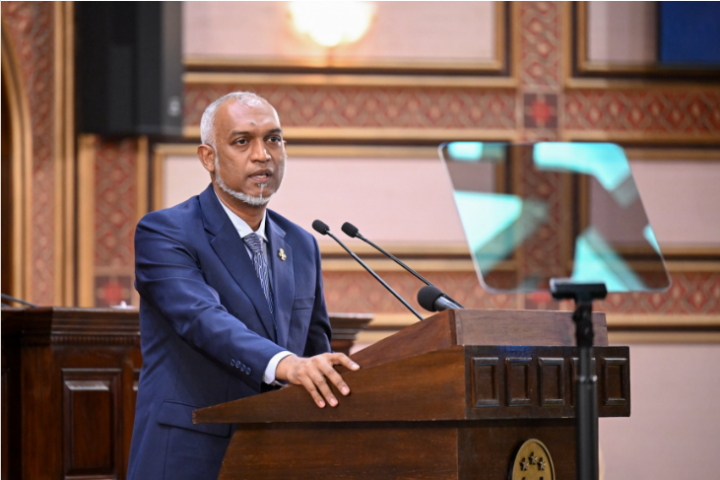
MALÉ — With two years remaining until the Maldives returns to the ballot box, President Dr Mohamed Muizzu’s Independence Day address served as a critical rhetorical pivot. The sting of the local council elections (LCE)—where the ruling coalition suffered severe urban defeats to the opposition Maldivian Democratic Party (MDP)—occurred some time ago, but its political reverberations clearly dictate the administration’s current posture. As his first major panoramic national speech since that electoral bloody nose, this was not merely a ceremonial address; it was a carefully curated manifesto designed to consolidate his nationalist base while tiptoeing around a fragile domestic economy.
Reading beneath the political grandstanding, one finds an administration relying heavily on the politics of sovereignty and blame to obfuscate mounting economic realities on the ground.
The ‘Maldives First’ Doctrine and the Ghosts of MDP
The ideological anchor of the address was a muscular, uncompromising foreign policy. Muizzu aggressively marketed his “Maldives First” doctrine, pivoting the archipelago toward a broader Islamic and non-aligned realignment. He highlighted the ban on Israeli passports as a moral imperative, showcased the revitalisation of SAARC, and championed the expulsion of foreign (Indian) military personnel. Furthermore, his constitutional amendment requiring a three-quarters parliamentary majority to alter national territory—coupled with his revival of claims over the Chagos Archipelago, was pitched as the ultimate safeguard of Maldivian sovereignty.
Crucially, this foreign policy triumph was weaponised as an indirect, relentless attack on the preceding MDP administration. Muizzu did not hold back, categorising the former government’s diplomacy as a “rubber stamp” policy that obediently swayed to foreign entities. He accused them of cowardly surrendering maritime borders and failing catastrophically on domestic security issues like gang violence and the drug trade.
This politics of blame was most surgically executed in his remarks on transparency. In a striking piece of political theatre, Muizzu cited the Information Commissioner’s recent announcement that government ministries had achieved 100% compliance with Right to Information (RTI) requests. Rather than presenting this merely as a routine bureaucratic update, Muizzu used the moment to pivot toward the political reality of the office, noting that the Commissioner is an individual who takes orders from the opposition. By framing it this way, the President implied that even an official aligned with or influenced by political rivals could not suppress or fabricate data against an administration whose transparency was undeniable. In doing so, Muizzu masterfully weaponised a watchdog’s findings to validate his own governance, while casting a shadow over the political motivations embedded within independent state institutions.
A Paradoxical Defence of Democracy
As he laid out his democratic credentials, the President offered a paradoxical defence of civil liberties. He rightfully boasted of tangible expansions in political freedom: the decentralisation of protest zones, state subsidies for journalism, and the proud assertion that no former presidents or political rivals currently languish in prison—a sharp contrast to the Maldives’ historical cycles of political revenge.
Yet, this democratic normalisation was delivered with a heavy dose of paternalism. His assurances of press freedom and judicial independence were wrapped in stern lectures on religious, cultural, and constitutional boundaries. It was a velvet-gloved warning: democracy and transparency are flourishing, provided they do not cross the administration’s newly defined sovereign red lines.
The Elephant in the Room: The Economy and the Youth
For a speech that meticulously itemised megaprojects and judicial reforms, what was glaringly absent was any honest reckoning with the daily economic anxieties of the Maldivian public. Did the President allocate equal time to the economy? He did not.
Muizzu painted a picture of administrative efficiency—touting “Maldives 2.0” digitalisation and the restructuring of state-owned enterprises (SOEs). However, he conveniently framed state layoffs and SoE downsizing merely as necessary, bloodless “efficiency” measures, entirely ignoring the social fallout and labour anxieties they have triggered. He offered no metrics on job creation, nor did he acknowledge the pressing woes of youth facing difficulties in securing employment and graduates struggling to service their student loans.
More critically, he remained entirely silent on the biting cost of living. The nation is grappling with rising inflation and a severe dollar shortage, with the Maldivian Rufiyaa (MVR) breaching the 20-plus mark against the US dollar on the parallel market. There was no mention of the suffocating delays at Maldives Ports Limited (MPL), where traders face mounting difficulties clearing cargo, a bottleneck that directly exacerbates consumer prices.
Furthermore, the President’s address seemed to look past the demographic reality of the next election. In two years, thousands of Maldivian youth will enter the electorate in their droves. While they were promised high-tech media villages and a digitised bureaucracy, they were offered no concrete economic roadmap. The lack of dialogue on youth unemployment, affordable living, and the purchasing power of the Rufiyaa suggests a perilous disconnect between the administration’s macro-nationalist victories and micro-economic realities.
The Two-Year Horizon
As Dr Muizzu looks toward the second half of his term, this Independence Day address is a masterclass in narrative control. He has successfully defined his legacy around indisputable sovereign victories and a defiant departure from the MDP’s foreign policy playbook.
However, nationalism cannot clear delayed containers at the MPL, nor can it close the widening gap in the dollar exchange rate. If the President hopes to secure a second term, the rhetoric of sovereignty will eventually have to pay the bills. If not, the politics of blame may find an entirely new target at the ballot box in 2028.