 News Desk
HIRIMARADHOO — With a stroke of the pen, President Dr Mohamed Muizzu yesterday made Hirimaradhoo the latest Maldivian island to be officially marked for abandonment. All 293 residents are to be relocated to Hanimaadhoo. The number of inhabited islands in the Maldives falls to 189.
It is a number that will keep falling.
What makes Hirimaradhoo’s story worth understanding is not just that a small island is being emptied. It is what had to fail before 293 people agreed to leave.
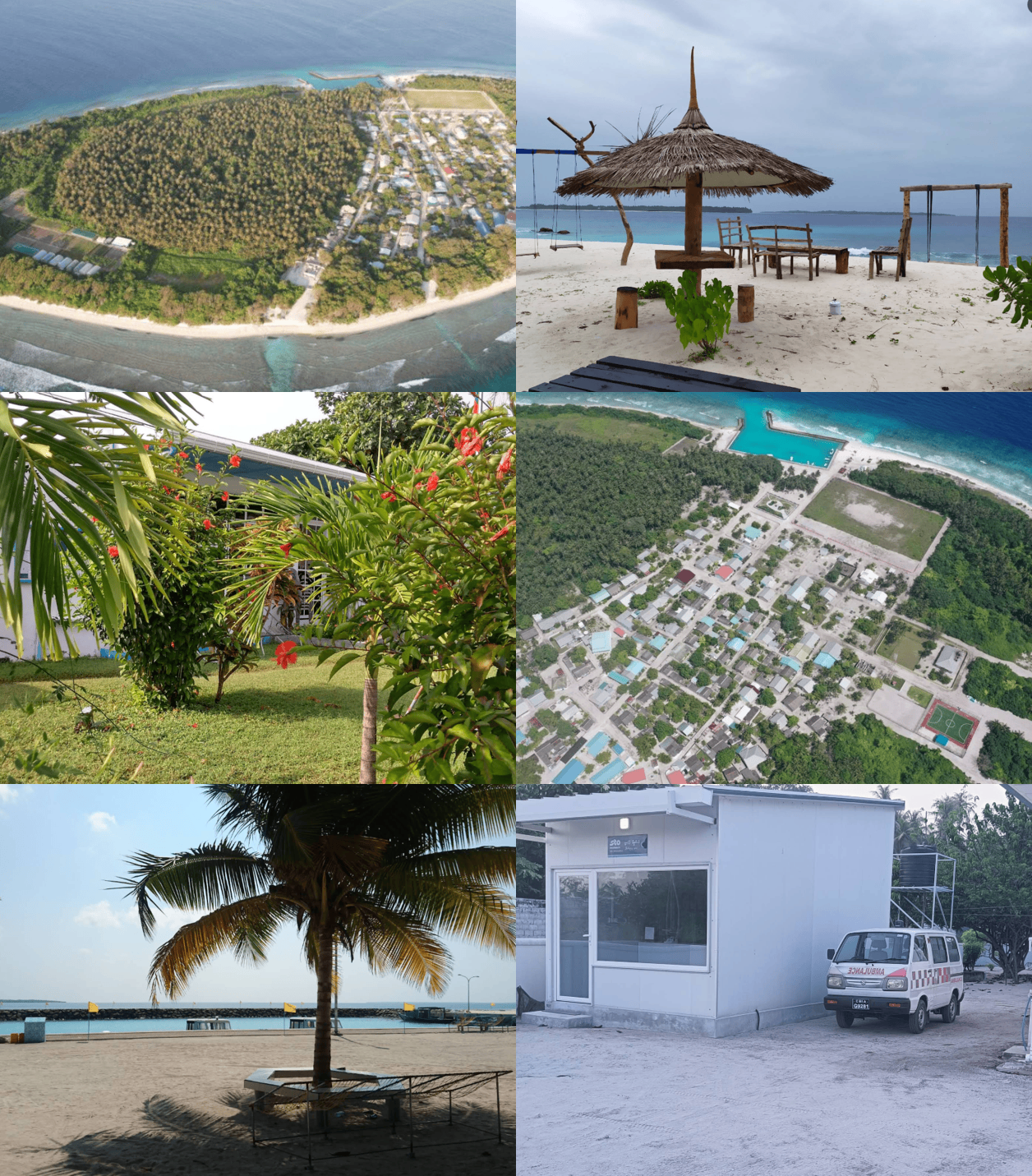
Every inhabited island in the Maldives, no matter how small, is a functioning state in miniature. Hirimaradhoo had its own powerhouse providing electricity, its own sewerage system, its own harbour, a health centre, a pharmacy, an ambulance, an ATM, and 4G mobile connectivity. It had a school. It had a council. A community with deep roots for generations. These are not people who lacked a reason to stay. They lacked the conditions that make staying possible.
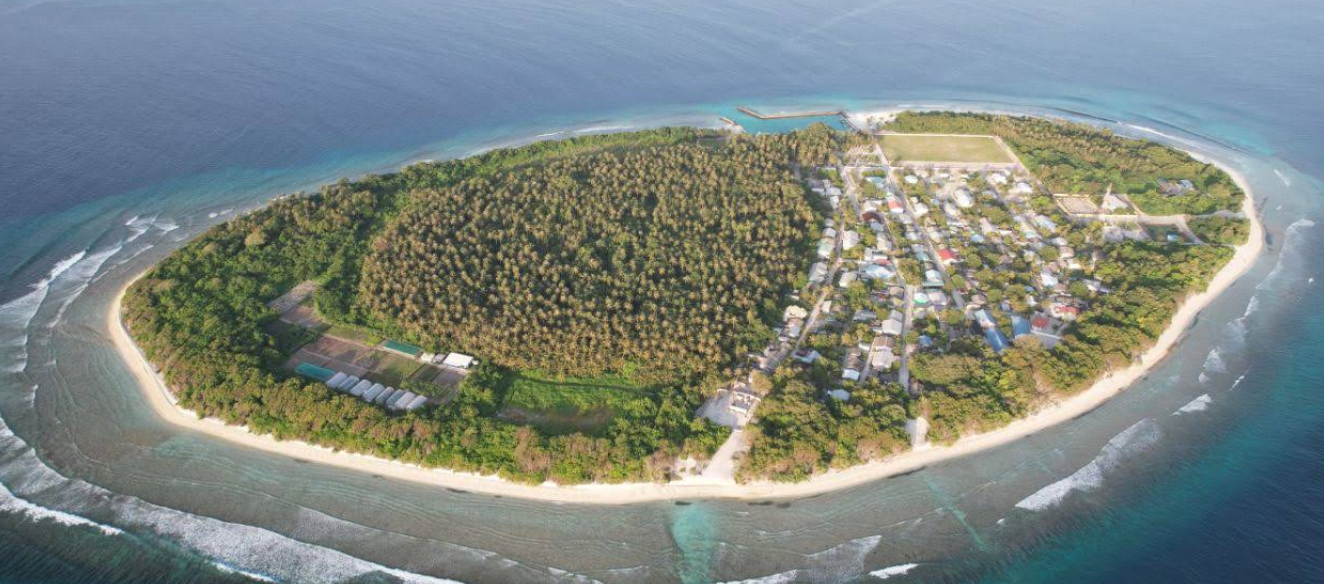
The island sits in Haa Dhaalu Atoll, about 280 kilometres north of Male’, the smallest of the atoll’s 13 inhabited islands. To get there from Male’ you fly an hour to Hanimaadhoo International Airport, then take a 15-minute speedboat. That airport is not far. You can see Hanimaadhoo from Hirimaradhoo on a clear day. And yet the two islands inhabit entirely different realities. Hanimaadhoo has an international airport capable of handling flights from India and beyond. It has a growing tourism economy, guesthouses, a resort. It is being developed as one of the regional centres of the northern Maldives.
Hirimaradhoo, just across the water, could not get a ferry to dock reliably.
The harbour problem is geological and financial. The approach is shallow and there is no good beach landing either. A harbour was eventually built, and for a moment people thought their troubles were over. They were not. The structure could not solve what the shallow seabed would not allow. In dry season, ferries still turned back. By the time that became clear, people had already made up their minds. The leaving had begun. A harbour that came too late, fixed too little, for a community that had already started voting with its feet.
One resident captured the island’s dilemma with a precision no census figure can match.
“How can we sustain? When we produce something, the buyer is the producer. When we have a sports tournament, the players are the spectators.”
A community folded entirely in on itself. Every transaction circling back to the same handful of families. No outside economy to sell into. No crowd to fill the stands.
Young people reached the same calculation on their own. There was not enough work, not enough opportunity, not enough reason to stay when Hanimaadhoo or Male’ were a speedboat ride away. They left in ones and twos, year after year, and the island kept a quiet count of their absence. The number of students sitting for O Level exams fell from 20 to one. One student. One exam hall. One last reminder of what a community looks like when it has already decided, in every practical sense, to go.
“The ferry turns back because it cannot come in. We are in such a situation,” one resident said. “The President listened to our grievances. He saw it with his own eyes.”
He did. And not long after, he signed the order.
The residents had asked to be relocated to K. Thulusdhoo, an island closer to Male’ with more established services and connections. The government had other plans. On 4 February 2025, it announced that Hirimaradhoo’s 293 residents would be moved to Hanimaadhoo, just across the water in the same atoll. Same north. Different future.
Whether that destination was what the community wanted is a separate question from whether the relocation itself was long overdue. It was.
Then came a detail that raised eyebrows. Just months after the presidential decree formally committing to relocate the island’s entire population, the government awarded a MVR 4.1 million (USD 266,017) waste and resource management project to be built on Hirimaradhoo. The timing coincided with local council elections. Was it an administrative oversight or something else? That question has not been answered. When pressed, the government said that as long as residents remain on the island, services must continue to be provided. It is a reasonable position. It is also the kind of answer that invites a formal information request.
The relocation plan itself is straightforward on paper. 184 land plots have already been allocated in Hanimaadhoo. President Muizzu has promised every family a plot and a house built within six years, with a framework agreement signed between the Ministry of Construction and the Housing Development Corporation to begin the work.
It is not a frictionless move. Residents of Hanimaadhoo protested earlier this year against the land allocations. Hanimaadhoo already has a housing shortage. Hanimaadhoo Council President said any development for the benefit of people is welcome, but cautioned that moving Hirimaradhoo residents before housing and basic services are in place would create its own difficulties. The government has also promised 500 housing units in Hanimaadhoo, though that construction sits on the same timeline as everything else.
Hirimaradhoo is not the first island in the northern atolls to send its people to Hanimaadhoo. Hathifushi, whose community had been requesting relocation for decades, was abandoned in 2007 after storm surges, with its 295 residents moving across. Hondaidhoo followed. Hirimaradhoo is the latest. Hanimaadhoo has become, in effect, the receiving island for communities the archipelago’s geography and economics can no longer sustain in their original locations.
You can find Hirimaradhoo on Google Maps at P2FC+QWH. A small green island, surrounded by water that looks impossibly blue from above. What the satellite image does not show is the shallow approach, the harbour that defeats ferries in dry season, or the one student left sitting O Levels in a school built for many.
The community will reassemble on a different island. What will remain on Hirimaradhoo is the reef, the shallow approach, the pristine waters that draw manta rays and guitar sharks and hawksbill turtles.
And no one left to watch the ferry turn around.