 News Desk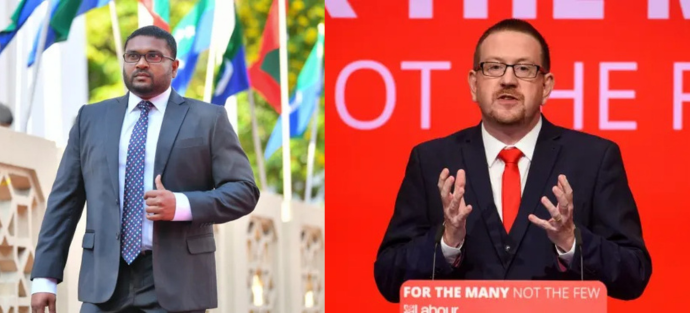
MALE’, Maldives—The chamber of the People’s Majlis reverberated last week with an uncomfortable silence after MP Abdul Rahman of Addu Meedhoo stood up to voice an extraordinary grievance. In a letter addressed to President Dr. Mohamed Muizzu, MP Abdul Rahman accused Defence Minister Mohamed Ghassan Maumoon of dismissing the people of Addu with scornful indifference. When confronted about unanswered calls concerning pressing issues from the southernmost atoll, the minister reportedly retorted that Addu was “not his concern.”
The incident, as trivial as it may seem in the grander scheme of politics, is anything but. It speaks to a deeper fissure within Maldivian governance—one where peripheral communities like Addu often find themselves treated as afterthoughts by the country’s central authorities. This is not just an interpersonal spat between a minister and an MP; it is a reflection of how fragile democracies can falter when their leaders fail to recognize the equal worth of all constituents.
The Maldives is not alone in facing such ethical crises. Across the globe in the United Kingdom, a similar story unfolded yesterday, albeit with a more dramatic flair. Andrew Gwynne, a Labour MP and Health Minister, was exposed for a series of offensive WhatsApp messages that mocked, vilified, and even wished death upon constituents who questioned him. His comments, ranging from outright hate speech to petty grievances, became public and triggered swift action: he was sacked from his ministerial role and suspended from the Labour Party.
These incidents, though separated by geography and context, offer striking parallels—and critical lessons. Both involve public officials who failed to uphold the basic tenets of their roles: respect for constituents and the dignity of their office.
The Maldives, a country of scattered atolls bound together by tenuous political and cultural threads, is particularly vulnerable to the dangers of neglect. Addu, the southernmost city, has long grappled with feelings of marginalization. In a nation where every island’s livelihood depends on its connection to the government in Male’, such dismissive remarks by a senior minister are more than just offensive—they are destabilizing.
Ghassan’s alleged comments—“Addu is not even my concern”—strike at the heart of a chronic issue in Maldivian politics: the sidelining of regional concerns. For the residents of Addu, who represent over 35,000 citizens, the statement reinforced the perception that their voices matter less in the halls of power.
It was not lost on the people of Addu that Ghassan had campaigned in their region during the last presidential election, promising progress and development in exchange for votes. To now declare that he has “nothing to do with Addu” exposes a pattern of political expediency that has long plagued the Maldives: promises made in campaign fervor are easily forgotten once power is secured.
The UK’s Andrew Gwynne provides a sharper, more abrasive parallel. In his case, the offence was not indifference but outright hostility. The leaked messages, which included a wish for the death of a 72-year-old constituent and derogatory remarks about women and minorities, were damning not just for their content but for what they revealed about Gwynne’s character.
Unlike the Maldives, where calls for accountability often fall on deaf ears, the UK acted swiftly. Gwynne was removed from his ministerial position and suspended from his party. The decisive action highlighted an important difference: while the UK’s institutions are far from perfect, they retain a capacity for swift self-correction when public officials cross ethical lines.
Despite the stark differences in scale and response, the two cases underscore a shared crisis of governance: the erosion of trust between public officials and the people they serve. In both nations, the incidents highlight the disconnect that can arise when leaders view constituents as mere numbers—or worse, as inconveniences.
For the Maldives, the stakes are particularly high. Its democracy is still young, and its geographic fragmentation makes regional representation a cornerstone of political stability. A government that ignores or disparages its outer atolls risks alienating vast swathes of the population, deepening the divides that already exist.
The UK case, while shocking in its vitriol, benefits from a political culture that demands accountability. The Maldives, by contrast, often struggles to enforce consequences for such misconduct. As MP Abdul Rahman’s letter urging an apology from the Defence Minister gains attention, it remains unclear whether President Muizzu will act decisively or let the matter fade into obscurity.
The Maldives can ill afford to ignore the lessons from both its own history and the Gwynne scandal in the UK. Respect for constituents is not optional; it is the foundation of democratic governance. Public officials must be reminded that their power derives not from their positions but from the people they represent.
Equally important is the need for institutional mechanisms that hold officials accountable. The UK’s swift dismissal of Gwynne serves as an example of how public trust can be partially restored when leaders act decisively. In the Maldives, where political patronage often shields officials from repercussions, establishing similar systems of accountability is not just advisable—it is essential.
The road to meaningful change, however, begins with a cultural shift. Maldivian leaders must move beyond viewing regions like Addu as electoral battlegrounds and instead see them as integral parts of the national fabric. The Maldives, like the UK, is at a crossroads. The choice is between continuing to tolerate indifference—or building a democracy where every citizen, regardless of their location or political alignment, is treated with the respect they deserve.
In the end, the true measure of a democracy is not how it handles its triumphs but how it confronts its failures. For both the Maldives and the UK, these incidents offer a sobering reminder that respect, accountability, and empathy are not just ideals—they are the lifeblood of good governance.