News Desk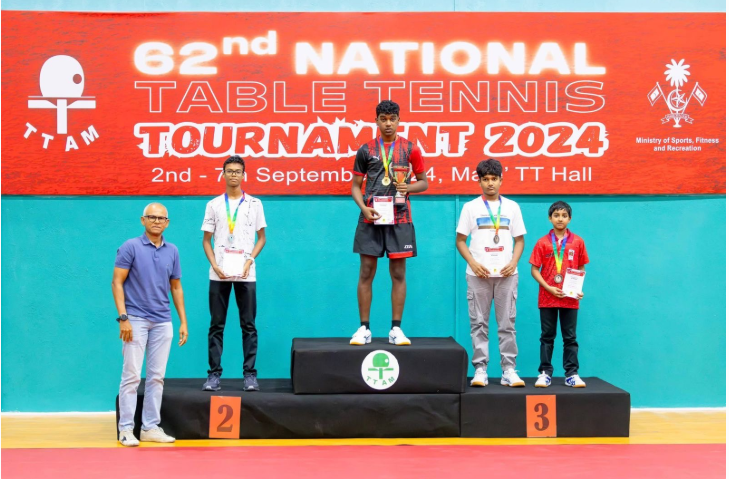
The Maldives’ National Sports Awards are meant to be a rare moment of uncomplicated pride — a stage where young talent is recognised for discipline, effort, and promise. Yet this year, the ceremony has been overshadowed by a storm of online hostility directed at one teenager who should have been celebrating a milestone, not defending his right to be there.
Eighteen‑year‑old table tennis player Umyr Mohamed Muizzu, nominated for Young Sportsman of the Year, has once again found himself thrust into a political battle he did not choose. His nomination, submitted by the Table Tennis Association, places him among five young athletes selected for their performance and potential. But instead of applause, he has faced a familiar wave of bullying and abuse — a pattern that has followed him long before this award season.
Those who have watched Umyr’s rise describe a young man who has earned his place the hard way. He has competed consistently, won gold medals at national and international levels, and secured first place in a 2024 tournament. Coaches speak of his discipline; teammates note his quiet determination. His achievements are documented, measurable, and visible to anyone willing to look beyond his surname.
Yet the online reaction has been swift, harsh, and deeply personal. Critics have framed his nomination as political favouritism, while supporters insist that a teenager’s sporting record should not be eclipsed by the office his father holds. The hostility reflects a broader truth: political divisions now seep into every corner of Maldivian public life, even into spaces meant to nurture the young.
Former Sports Minister Ahmed Mahloof, now Ambassador to Japan, intervened with a rare cross‑partisan appeal. He reminded the public that Umyr’s nomination came from the federation, not the government, and that the teenager’s achievements long predate the current administration.
“Stop politicising the success of such hard work of children,” Mahloof wrote on X — a pointed reminder that the target of this outrage is not a policymaker but a child who has spent years training, competing, and improving.
Mahloof also noted that Umyr had been part of the previous government’s Arutha youth programme, underscoring that his development as an athlete has spanned political cycles.
The defence did not come only from former officials. It came from home. Umyr’s uncle, Ali Arif, took to X with a heartfelt plea — almost a cry of exhaustion — urging the public to stop the harassment and to recognise that the teenager’s nomination was earned, not inherited. His words carried the frustration of a family that has watched a young athlete repeatedly dragged into political crossfire simply because of his surname.
Some PNC activists have voiced similar sentiments, arguing that Umyr’s place on the shortlist reflects years of training rather than political privilege. The Table Tennis Association’s decision to nominate Zeek Hassan Latheef alongside him further underscores that the category is grounded in performance, not pedigree — a reminder that the award is meant to honour talent, not lineage.
The Maldives is entering the eighteenth year of its modern constitution — the document that opened the door to multiparty democracy. But political maturity does not arrive overnight. The country is still learning how to disagree without destroying, how to debate without demeaning, and how to protect the young from becoming collateral in adult conflicts.
In a nation of half a million people, anonymity is impossible. Every name carries history; every family carries associations. When a teenager becomes the subject of national debate, the impact is immediate and personal. The scrutiny is not abstract — it arrives in the form of comments, insinuations, and pile ons that spread rapidly through a tightly connected society.
This is not the first time Umyr has been targeted. His achievements have repeatedly been overshadowed by political noise, turning what should be moments of encouragement into episodes of public pressure. For a young man preparing for university life and early adulthood, the emotional toll is not insignificant.