News Desk
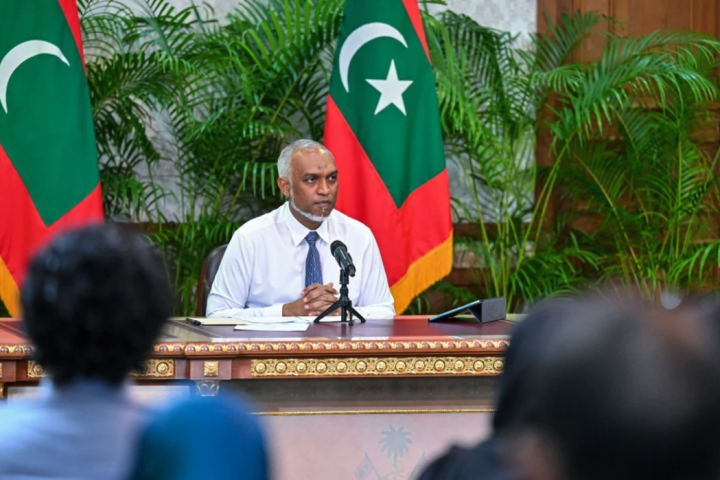
MALE’ — The desk was not much to look at. A modest piece of furniture, the kind you would pass without noticing. But five presidents had sat behind it. Maumoon Abdul Gayoom used it first. Then came Mohamed Nasheed, then Mohamed Waheed, then Abdulla Yameen, then Ibrahim Mohamed Solih. Bills were signed on it. Decisions that shaped this country were made at it. Last week, the President’s Office sold it at auction for MVR 12,500.
Nobody has said why.
The table going is one of three things that happened in the same week that, taken together, say something about how President Dr Mohamed Muizzu runs a government and whose company he keeps when he needs to fill a post.
Clarification
President’s Office Says Auctioned Table Was Not Used by Any Former President
The President’s Office has pushed back on reports that a desk used by five Maldivian presidents was sold at auction for MVR 12,500, saying the table in question was never used by any head of state.
Chief Government Spokesperson Mohamed Hussain Shareef said the desk was put up for auction because termite damage had rendered it unusable and beyond reasonable maintenance, and that it was disposed of through the standard government process for auctioning state property. He added that any furniture auctioned by the President’s Office has the state emblem removed before it is listed.
Shareef said someone had altered the table or the images circulating in media to make it appear as though it was the official desk used by former presidents, and that this framing had then been pushed through media channels.
The clarification came after the President’s Office faced criticism over the reported sale.
Azima Shakoor has been appointed Principal Secretary at the President’s Office. She is Muizzu’s family lawyer. She represented First Lady Sajida Mohamed in legal cases brought against various parties. She ran for Male’ City Mayor on a PNC ticket and lost to Adam Aazim. She has also worked during the years of Waheed and Maumoon, and she was a visible figure during the emergency period under Yameen, the years that many Maldivians would rather not revisit in detail.
The appointment came on the same day, or thereabouts, that Muizzu has been publicly saying the government will not be filling political posts in order to cut costs. State-owned companies are shedding staff. The belt, officially, is being tightened for ordinary citizens. Azima Shakoor’s appointment does not appear to have been announced with any particular fanfare, which may be why it did not immediately attract the attention it deserves.
Then there is Abdul Azeez Jamal Aboobakr, whose name Muizzu has sent to Majlis for confirmation as Information Commissioner, following the end of the term of Ahmed Aahid.
Muizzu has not been quiet about his feelings toward Aahid. He said recently that the outgoing commissioner takes orders from the opposition to act against the government, which is a remarkable thing for a president to say about an independent officer whose entire function is to hold the government accountable for withholding information from the public.
It is worth noting that the Information Commissioner’s office fined the President’s Office last month, on 13 June, for obstructing the commissioner’s ability to carry out his legal duties. Multiple complaints about the government refusing to release information have been filed with the commission. Several have ended up in court.
Into this role, Muizzu has nominated Abdul Azeez Jamal, a name associated with the Yameen years.
There is a pattern here that is worth naming plainly.
Muizzu came to office partly on the strength of a broad coalition that included people exhausted by what came before, people who wanted something different. He expelled Indian military personnel after a loud India Out campaign, distanced himself from the MDP’s legacy, and positioned himself as a break from the past.
And yet the faces appearing in his office are not new faces. They are faces from earlier chapters of Maldivian political history, chapters that did not always end well for the public. A lawyer from the family circle. A figure from the Yameen emergency era. A nominee for a watchdog role drawn from the same political generation that the watchdog was created to watch.
The human resources of previous administrations, it turns out, are quite useful. The legacies, apparently, are another matter. Those can be sold at auction for MVR 12,500.
The table, at least, has found a new home. What was decided on it stays in the record, whether the furniture is there or not.