News Desk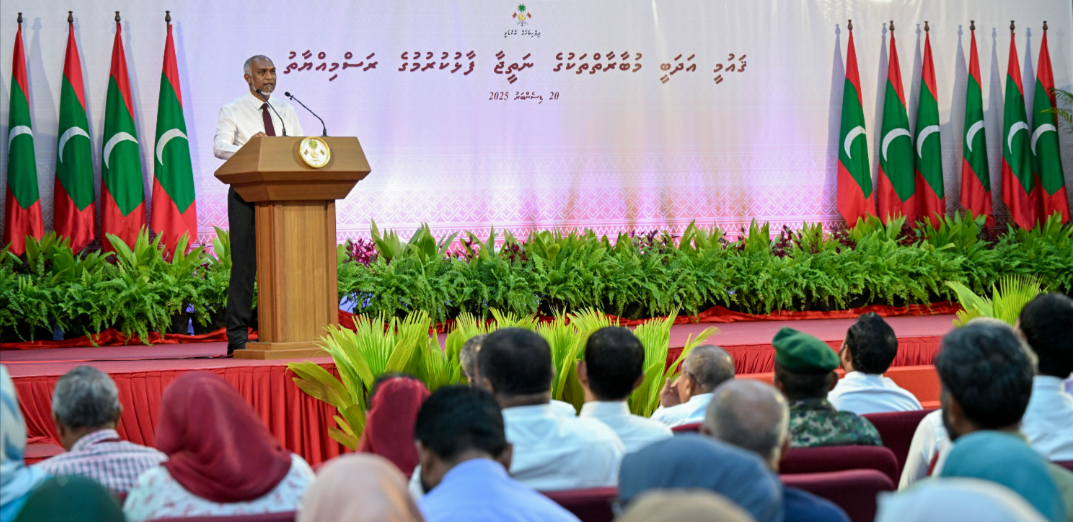
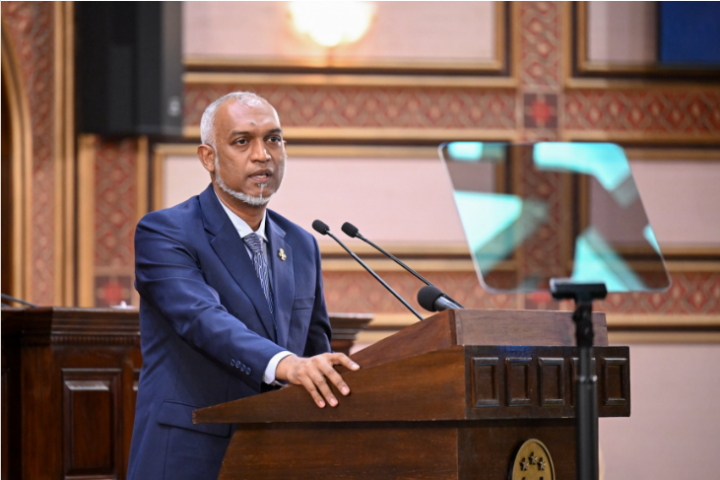
MALÉ — The evening unfolded beneath the quiet weight of history. At Salahuddin School, a modest but symbolically charged building named for the scholar who helped shape the Maldives’ first formal education system, President Dr. Mohamed Muizzu stood before a hall of writers, students and officials and pledged a renewed national commitment to Dhivehi literature.
The school’s namesake, Hussain Salaahudeen—prolific author, translator, and one of the earliest architects of Maldivian intellectual life—hovered over the ceremony like an unspoken reminder. More than a century ago, Sultan Imaadudeen began the country’s first steps toward formal schooling; it was Salahuddin who later nurtured that early experiment into a meaningful intellectual project. His translations and original works enriched Dhivehi at a time when the language was still finding its modern form. On this night, his legacy framed the president’s message: that the country must reclaim and strengthen its literary identity.
The event, held to honour the winners of the National Literary Competitions, quickly became a platform for a broader cultural agenda. President Muizzu announced that beginning next year, the government will introduce special arrangements to support the publication of books by Dhivehi authors. He also unveiled plans for a national competition to produce children’s short films on Maldivian language, culture, history and heritage—an attempt, he said, to fill a void in locally rooted content for young audiences.
From the tone of the speech, the direction was unmistakable: the government’s encouragement is aimed squarely at writing in Dhivehi. A new generation of Maldivian writers has emerged in recent years, but most gravitate toward children’s books—stories for very young readers, easier to produce and easier to publish. More demanding forms of writing remain rare, and the president acknowledged the gap.
Dhivehi, he said, is a core element of Maldivian identity. High‑quality children’s books are essential if the language is to be passed on “meaningfully and securely” to future generations. Yet many aspiring and established authors struggle to get their work published, a challenge he described as a major national concern. The government, he promised, is committed to resolving it.
But the obstacles run deeper than the president’s speech suggested.
For decades, the Maldives has struggled to build an intellectually vibrant public sphere, in large part because successive governments have kept tight control over publishing, public discourse and the very institutions that should have nurtured independent thought—constraints that have left freedom of expression fragile and unevenly protected. There is no active translation movement. No sustained literary or scholarly culture. Writers often work alone, without institutions that nurture debate, experimentation or long‑term intellectual projects. The country’s literary ecosystem remains thin, fragile and heavily dependent on individual effort.
President Muizzu acknowledged some of this indirectly, calling literature a vital component of national heritage and arguing that strong writing and speaking skills are fundamental to national development. He spoke of a “transformative shift” he hopes to bring to literary ethics and culture.
He also addressed a recurring public complaint: the scarcity of children’s cartoons and films depicting national events or rooted in local culture. The new short‑film competition, he said, would come with substantial prizes to encourage participation. And beginning next year, the Dhivehi Thaana Handwriting Competition will be formally organised as the National Handwriting Competition for the President’s Prize—another attempt to elevate the language’s visibility.
Yet even as he spoke of institutional support, the president gestured toward a more complicated reality. He referenced his initiative to create a Ministry of Dhivehi Language. The ministry exists, but beyond administrative work, its impact on elevating the language or expanding the country’s intellectual output remains unclear. Many writers say the real barriers lie elsewhere.
Publishing a book in the Maldives is entangled in layers of regulation and censorship. To obtain a Maldivian ISBN, an author must take a completed manuscript to the National Classification Bureau, search a government register for an approved validator, and secure a letter from that person before the ISBN is issued. The process requires physically handing over the manuscript to the agency — a step that raises uncomfortable questions about intellectual property and the security of unpublished work. If a manuscript changes hands, who guarantees the author’s rights? When confronted with this concern, staff at the Classification Bureau said that “so far no such thing has happened.” That reassurance may suffice for children’s books, which dominate the local publishing landscape, but writers ask what it means for scholarly work, political analysis, or any serious intellectual project that depends on confidentiality and academic independence. The system revolves around a certificate known as the foi faaskuraa card—a bureaucratic controlling tool that has long obstructed intellectual work.
Even with multiparty democracy and media freedoms that are rare in South Asia, the Maldives continues to regulate authorship and constrain intellectual expression, leaving writers to navigate a system where freedom of expression exists in principle but remains tightly managed in practice.
One Maldivian writer who recently published a book said he avoided the process entirely: he wrote in English and obtained his ISBN from Sri Lanka. It was faster, simpler and free of the restrictions that govern Dhivehi publishing.
For many in the literary community, the president’s call to support Dhivehi authorship is welcome—long overdue, even. The country has needed a serious national effort to protect and develop its language. But writers argue that if the Maldives truly wants Dhivehi literature to grow, the culture of censorship must be dismantled. Only then, they say, can the country prepare itself for an age defined by information, exchange and open intellectual life.
The ceremony ended with the president presenting awards to the first‑place winners of this year’s National Literary Competitions, while First Lady Sajidha Mohamed handed prizes to the second‑place winners. It was the first time the event, organised by the Dhivehi Language Academy, was held at the national level. Cabinet ministers and senior officials filled the hall.
As the audience dispersed into the warm Malé night, the questions lingered. Can a government that regulates literature also revive it? Can a language flourish when its writers must navigate bureaucratic gatekeepers? And can the Maldives, a nation that once produced scholars like Salahuddin, rebuild the intellectual life it has long lacked?
For now, the promises have been made. The legacy of the scholar whose name graces the school waits to see whether the country will rise to meet them.
About Dhivehi Language:
Dhivehi, the national language of the Maldives, is a unique Indo‑Aryan tongue spoken across a chain of islands scattered through the Indian Ocean. It carries echoes of Sanskrit, Urdu, Arabic and South Asian coastal cultures, yet it has evolved into something distinctly Maldivian—shaped by seafaring, trade routes and centuries of island life.
Written in Thaana, a script that reads right‑to‑left and blends numerals with phonetic symbols, Dhivehi is both visually striking and historically layered.
It is also a language that entered the digital age early: Thaana was incorporated into Unicode in the 1990s, giving Dhivehi a place in global computing long before many small languages secured similar recognition.
Today it is fully supported across modern operating systems, keyboards and digital platforms, allowing Maldivians to write, publish and communicate in their own script without technological barriers. For Maldivians, Dhivehi is more than a means of communication—it is the vessel of oral poetry, folk tales, Islamic scholarship and the intimate vocabulary of island communities. In a globalizing world where small languages often recede, Dhivehi stands as a reminder that linguistic identity can anchor a nation’s sense of self even as it navigates the pressures of modernity.
About Maldives:
The Maldives is a small island nation in South Asia, remarkable as the only known civilization to have developed and thrived entirely without a river system—a feat unmatched in the historical record of settled societies.
It is also the oldest continuously unified country in South Asia, with a documented history of centralized rule stretching from its northernmost atolls to its southern edge.
Long before many of its neighbours formalized their political systems, the Maldives adopted a written constitution, and its parliament—today known as the People’s Majlis—has a recorded institutional history of nearly a century.
For a nation of scattered coral islands, this continuity of governance and political identity is one of its most enduring achievements.
Sanskrit Connections: The Shaviyani Sound Debate in Maldivian Language