News Desk
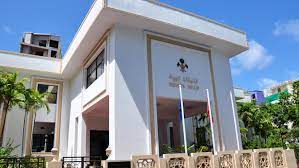
MAAFUSHI, Maldives — In the maximum‑security wing of Maafushi Prison, a man in his fifties lies awake most nights, staring at the fluorescent light that never quite dims. Sleep comes in fragments. When it does, he says, the ghosts arrive — the faces of those he harmed, the ones he insists reach for his throat the moment he closes his eyes. He wakes with a jolt, breathless, as if surfacing from a long dive.
He has spent decades running from those shadows. Now they have nowhere else to go but into his dreams.
His story begins long before the crimes that made headlines. It begins in 1992, when he was still a boy — a juvenile by age, but already branded a “repeat offender,” too unruly for the state to manage. He was placed in an adult detention facility, a decision that would shape the rest of his life. Only after intervention was he transferred to Feydhoo Finolhu, then a juvenile correction centre run by a tangle of state agencies, each with its own mandate and none with a clear plan for boys like him.
KN, a name used at her request to protect her privacy, met him there. At the time, she was a young social worker assigned to complex juvenile cases — the kind that demanded patience, persistence, and a willingness to see past the labels. In the years that followed, she would move into child‑protection work and later into senior roles across rights‑based and community‑welfare institutions, positions that gave her a wider view of how the system repeatedly fails boys like him. But back then, she was simply the person assigned to a teenager who refused to speak.
“He kept his fist closed all the time,” she recalls. “It was the fist that once held a knife. Even without the knife, he held it as if he was still gripping the blade.”
It took weeks of patient conversation — or attempts at conversation — before he loosened it.
The Gang Years
The early 1990s were the years when gang culture first took root in Malé. Teenagers drifted into small neighbourhood crews, half‑students, half‑street soldiers. Membership came with rituals: stealing a bicycle, slashing a motorcycle seat, proving you were willing to cross a line and not look back.
He crossed it early.
When KN first saw him, his face was hidden behind a curtain of long hair. Only his eyes showed — dark, watchful, unwilling to trust. The institution saw him as hardened. He saw the institution as another enemy.
But slowly, something shifted. He began praying at the island mosque. He cut his hair. And when he did, the story he had been hiding became visible: a long scar running from ear to ear, sweeping across his cheeks and down to his chin. A rival gang member had dragged a box cutter across his face during a fight. It was a mark he carried like a certificate — proof of survival, proof of belonging, proof of the life he had been forced into.
After the haircut, he became a different young man. He even led prayers for other boys at the facility. “Human connection can do that,” KN says. “When someone finally listens, the nervous system begins to settle. The body stops bracing for attack. That’s when change becomes possible.”
Psychologists describe this as the first step in rehabilitation: the slow rewiring that happens when a person, long conditioned to expect violence, encounters consistent empathy instead. The brain learns safety. The body learns to unclench. Even the closed fist begins to open.
A Chance at Escape — Then a Collapse
By the time he completed his sentence, he had made remarkable progress. The facility wanted to release him to his family. But he resisted. He feared the society that had shaped him, feared the streets that had taught him to fight before he could vote.
He dreamed of leaving the country, studying abroad, starting over. He had a sister in a neighbouring country and asked to join her. His father agreed. The authorities approved. The family saved for his airfare.
But when he was finally released, the World Cup had begun. His father used the money — all of it — to buy a television, a projector, and a screen so the neighbourhood could watch the matches.
With every goal, the neighbours erupted in cheers. For the boy who had pinned his future on that ticket, each cheer felt like a blow from inside his skull.
The nights were loud. The days were dull. His father slept through the mornings, exhausted from football celebrations. No one asked the boy how he was coping. No one asked what he needed.
He slipped back into the only community that welcomed him: the gang world.
The Label Becomes the Man
Once he returned to the streets, the state remembered him only as a name on a list. Every crime, every disturbance, every rumour — he was summoned, questioned, released. Sometimes he was involved. Often he wasn’t. But the label stuck, and eventually he lived up to it.
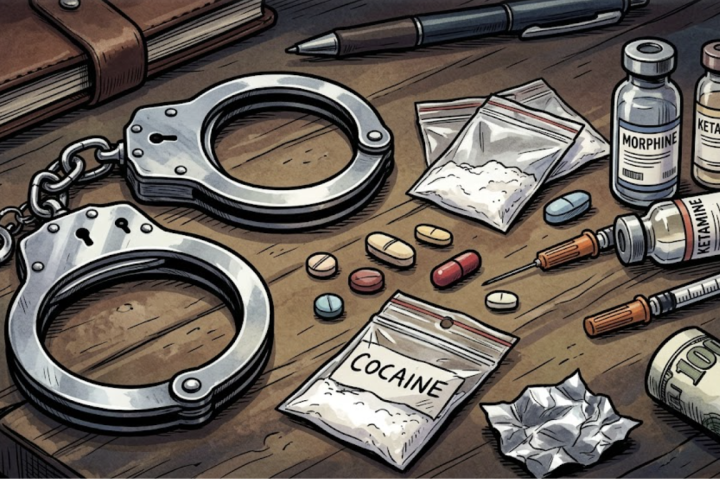
In the Maldives, crime rarely exists without two ingredients: drugs and politics. Drugs shape the foot soldiers. Politics funds the operations. He became useful to both.
He was hired for odd jobs — the kind of jobs that required silence, loyalty, and a willingness to do what others would not. Over time, he became a professional in his own right. And then he became something worse.
He was asked to kill.
The case shocked the nation, not because of his record — which only social workers and field officers knew — but because of the reputation of the victim. The crime cemented his place in the public imagination, though the public never knew the full story of how he got there.
Forgotten by the State That Made Him
“He is a state‑created criminal,” KN says today. “We failed him at every stage.”
Now he sits in Maafushi’s maximum‑security wing, alone with the ghosts that visit him at night. Society has forgotten him. The state that shaped him has moved on.
But in the quiet hours, when the lights hum and sleep refuses to come, he remembers everything — the scar, the closed fist, the missed chance at escape, the father cheering at a World Cup match while his son’s future dissolved in the noise.
And in those moments, he is no longer the monster the headlines made him. He is simply the boy the system never learned how to save.
Reforms introduce a multi‑tiered process for identifying and declaring criminal gangs.
Maldives first introduced a law specifically criminalizing gang violence on 5 September 2010, known as the Law on Criminalizing Gang Violence. That law remained in force for fifteen years, until it was abolished on 25 August 2025. On the same day, a new framework — Law 7/2025, the Prevention of Gang Crimes and Other Dangerous Crimes Act — came into effect.
Under the new Act, the process of formally designating a criminal group as a gang begins with the police. They must submit the case to the Prosecutor General, who is required to review the evidence and forward it to the High Court. Only the High Court has the authority to declare a group a gang.