News Desk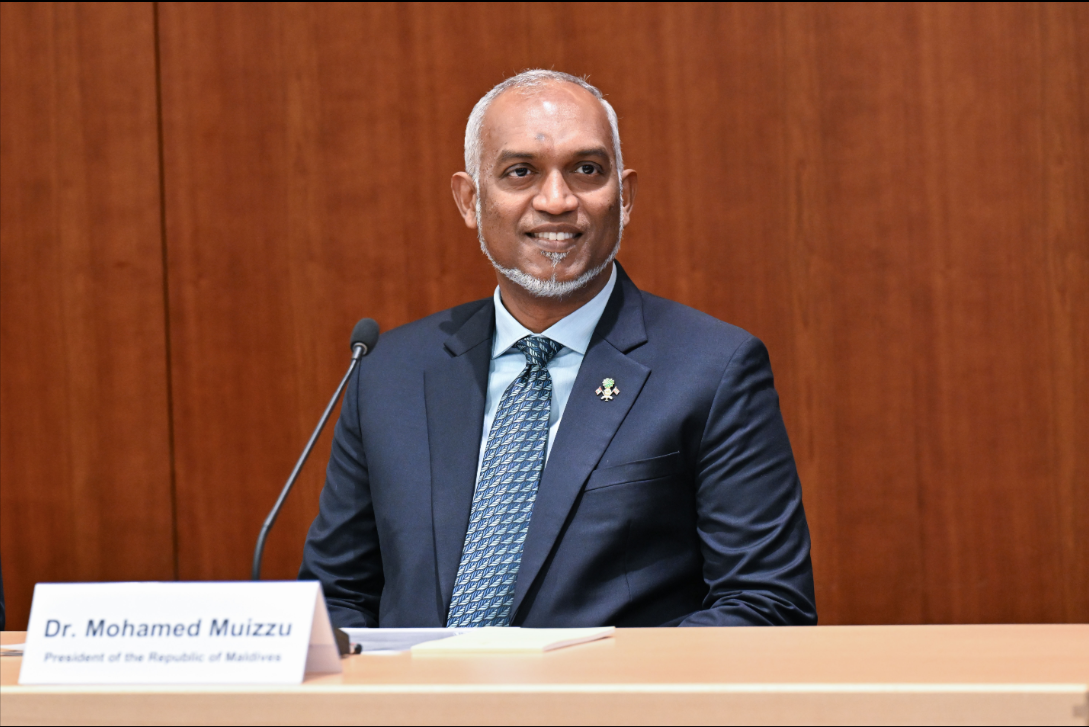
BERLIN — For decades, the Maldives has been defined by a narrative of fragility, portrayed by successive leaders as vulnerable, dependent nation bound by the narrow scripts usually reserved for small island states. But in a mahogany-trimmed room in Berlin this week, President Dr Mohamed Muizzu sought to dismantle that legacy of helplessness, replacing it with an assertive brand of leadership that suggests if the rest of the world can innovate, so too can the Maldives.
Addressing the Maldives-Germany Business Roundtable, President Muizzu arrived with a message designed to soothe the anxieties of European capital.
He spoke of “Vision 2040,” a strategic roadmap that seeks to transition the archipelago from a holiday destination into a diversified, digitally integrated economy. It was a pitch tailored for a German audience, heavy on the language of engineering, fiscal discipline, and institutional endurance.
The President’s rhetoric was notably pragmatic. He acknowledged the “polycrisis” of the modern era, a cocktail of climate risk, economic volatility, and technological disruption. For his nation, he argued, these are not distant threats. “For countries like the Maldives, these pressures are not abstract. They are immediate and real,” President Muizzu said. “But they also compel us to think differently; to innovate, adapt, and to find solutions that are practical, scalable, and durable.”
There is a sense of urgency in the administration’s timeline. President Muizzu set a target for the “creative economy” to account for 15 percent of GDP by 2030 and pledged that 33 percent of the country’s electricity demand would be met by renewable energy by 2028. To back these claims he pointed to a historic high in gross official reserves of 1.13 billion dollars.
“These reforms are already producing results,” he told the assembly, citing a reduction in the budget deficit to 5 percent of GDP. “This renewed confidence is also reflected in investor behaviour, with global technology leaders such as Google choosing the Maldives for strategic, long-term infrastructure investments.”
For the German Chamber of Commerce and Industry, the appeal lies in the specific sectors the President highlighted. Beyond the traditional luxury tourism model, President Muizzu invited investment in medical technology, sustainable townships, and financial services. He pointed to “Project Ayla” and “Project Solar City” as evidence that the Maldives is moving toward a more structured, urbanised future.
The timing of the visit is significant. As the Maldives navigates a complex geopolitical landscape, this outreach to Germany signals a desire for “precision” and “rules-based” partnerships. President Muizzu was explicit that he was looking for more than just a balance sheet entry.
“The Maldives is not seeking short-term capital or speculative interest,” the President said. “We are looking for partners who are prepared to engage constructively, invest responsibly, and contribute to solutions that last.”
President Muizzu’s performance in Berlin suggests a leader who understands that in the current global economy, survival depends on being more than just a beautiful backdrop. By framing the Maldives as a pioneer in resilience, he is betting that German expertise can help his nation outrun the rising tides. “Progress today depends less on scale and more on collaboration,” he concluded. “On partnerships that bring together experience, technology, and shared trust.”