News Desk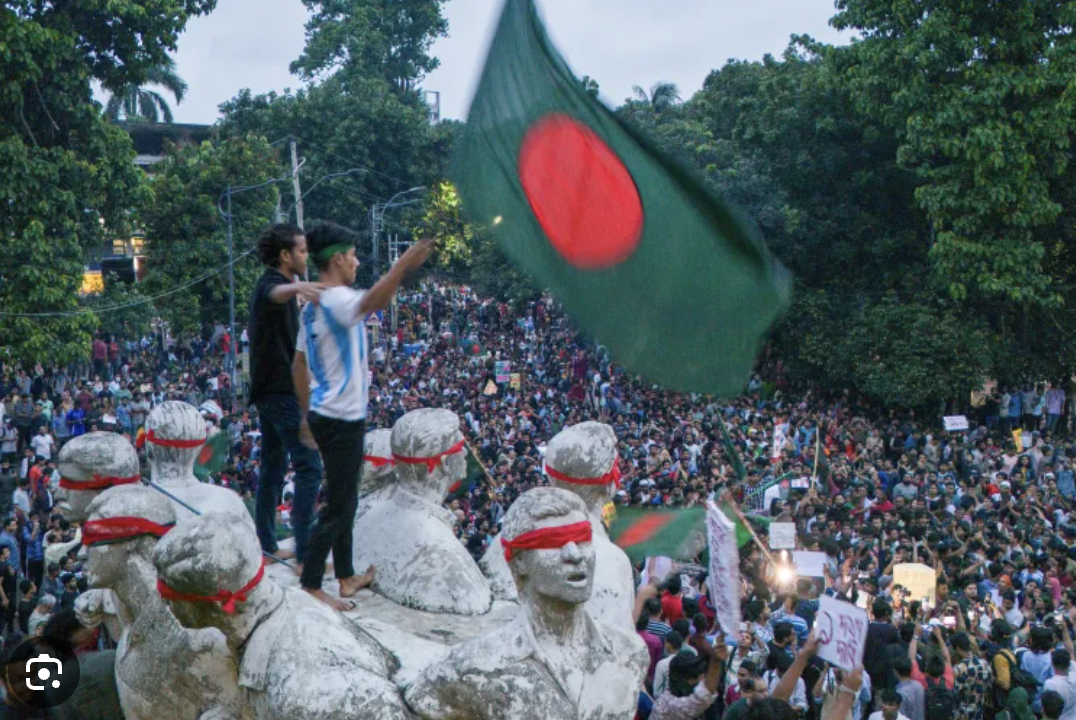
Ahead of the national elections in Bangladesh on February 12, Jamaat-e-Islami has formed a large alliance. The party’s previous eight-party alliance of Islamic parties has recently been joined by the National Citizens’ Party (NCP), a party of student leaders from the July-August mass uprising, the Liberal Democratic Party (LDP) led by Colonel Ali Ahmed, and later the Amar Bangladesh Party (AB Party) led by former Jamaat leader Mojibur Rahman Monju . By forming a large 11-party alliance, they have created quite a stir in the field of politics as a formidable competitor. However, there is considerable doubt about how successful this alliance will actually be.
Following the political upheaval in Bangladesh on August 5, 2024, Sheikh Hasina’s political party, the Awami League, was banned. The election is now being held under an interim government after almost a year and a half. With the Awami League banned, the main competitors in the political arena are now the Bangladesh Nationalist Party (BNP) and Jamaat-e-Islami.
Due to its pro-Pakistan role in the 1971 Liberation War, Jamaat-e-Islami has always been controversial in Bangladeshi politics. It has never been able to build a strong independent voter base. Various electoral analyses show that the party’s individual vote share was usually limited to around 12 percent. BJI got the highest vote in 1991 and it was 12.2%. They got 4.28 % during its alliance with the Bangladesh Nationalist Party (BNP) in the 2001 national elections. In 2008, they achieved a 4.6%. However, with the Awami League banned, the context for Jamaat’s electoral prospects has changed. Furthermore, with the NCP, a party of student leaders from the mass uprising, joining the electoral alliance, the alliance believes it will perform well in the upcoming elections. But is that really the case?
After Osman Hadi, a leader of the July mass uprising and convenor of the Inqilab Manch, was shot and wounded on December 12 and died on the night of December 18, sympathy for Jamaat increased considerably. It was thought that Jamaat’s public support had grown. However, on the night of Hadi’s death, the burning of renowned newspapers like Prothom Alo and The Daily Star, and the offices of cultural organizations like Udichi and Chhayanaut by a mob, sparked renewed controversy. Several leaders of the party’s student wing- Chhatra Shibir- openly spoke about vandalizing these institutions. These statements, which spread on social media, have created widespread negative reactions. These incidents have further strengthened the perception that Jamaat-e-Islami leaders were directly involved in multiple attacks.
The political landscape shifted even more after the death of former Prime Minister and BNP Chairperson Khaleda Zia. The massive turnout at her funeral and the outpouring of sympathy from home and abroad significantly strengthened the BNP’s position. Public support for Tarique Rahman also visibly increased. Despite the current uncertainty, most analysts still consider the BNP to be in a stronger position. In this situation, some online activists made controversial and politically inflammatory comments regarding Khaleda Zia’s death, which backfired severely on the party. The failure to provide credible evidence to support their claims further increased public resentment towards Jamaat.
The National Citizen Party (NCP) has also faced various controversies after joining the Jamaat-led alliance. Although the party emerged under the leadership of figures associated with the mass uprising, it quickly experienced serious internal divisions. At least 13 central leaders have already resigned, and many more are reportedly preparing to do so. In particular, the NCP’s female leaders have taken a direct stand against Jamaat. This internal fragmentation has further highlighted the fragile state of the entire alliance.
Jamaat-e-Islami’s role in student politics has also come under intense criticism. It is alleged that they (Chhatra Shibir) won student union elections by using their panel and so-called ‘independent’ candidates who are linked with Chhatra Shibir. These “independent” leaders, especially RUCSU Leader, are involved in the mob, forcing teachers to resign, forcing hawkers to stay away from the campus, vandalising Bangabandhu Murals. are secretly considered to be Shibir cadres. There are further allegations that these cadres have been used to exert pressure and organize crowds in various locations. Such activities are no longer a secret, and this has led to continuous criticism of Jamaat.
Adding to this is the recent statement by the Jamaat Amir, who proposed decreasing women’s daily working hours to five hours, sparking widespread criticism. Working women viewed this as an attack on their freedom and professional rights and interpreted it as an attempt to confine women to the home. Further controversy arose when the Jamaat-e-Islami’s leader admitted to having held a secret meeting with an Indian diplomat. For a long time, Jamaat has presented itself as an anti-India party, and its top leaders frequently deliver anti-India speeches. In this context, the belated admission by Jamaat Ameer of the secret meeting has raised serious questions about the party’s stance and credibility. Many observers view this as a major political blunder.
Moreover, the Jamaat-e-Islami has been running its alliance with eight other islamic parties. Among them, Chormonai Pir’s Islami Andolan Chief is one of the largest party. However, despite being the largest alliance on paper, the two parties are poles apart in terms of ideology and they have conflicts in so many things. Charmonai Pir frequently makes anti-Jamaat statements and has even called Jamaat a party of infidels on several occasions. Although they are formally in an alliance, the party’s activists are intensely feels enemy each other. Beyond this alliance, the largest coalition of Islamic parties is considered to be Hefazat-e-Islam. Their role in the electoral arena is also significant. They refuse to recognise the Jamaat-e-Islami-led alliance as a legitimate Islamic coalition.
Recent opinion polls and surveys indicate that the Jamaat-led alliance is significantly behind in terms of potential votes. Since the fall of Sheikh Hasina’s government on August 5th, Bangladesh has been going through a period of instability and fragility. Various decisions and actions of the interim government led by Muhammad Yunus have also been criticized. Nevertheless, the announcement of the election date has moved the political process forward to some extent.
However, the fear of violence and attacks surrounding the election still remains. Many fear that the Islamist extremist groups, known to be influenced by Jamaat, could pose a significant security risk. How these specific groups will be controlled during the election period remains a question.
In conclusion, despite forming a large alliance, Jamaat has failed to establish a strong position in the electoral arena. Whether this alliance will be able to exert any significant influence, or whether Jamaat will become even more marginalized in the political reality, only time will tell.