News Desk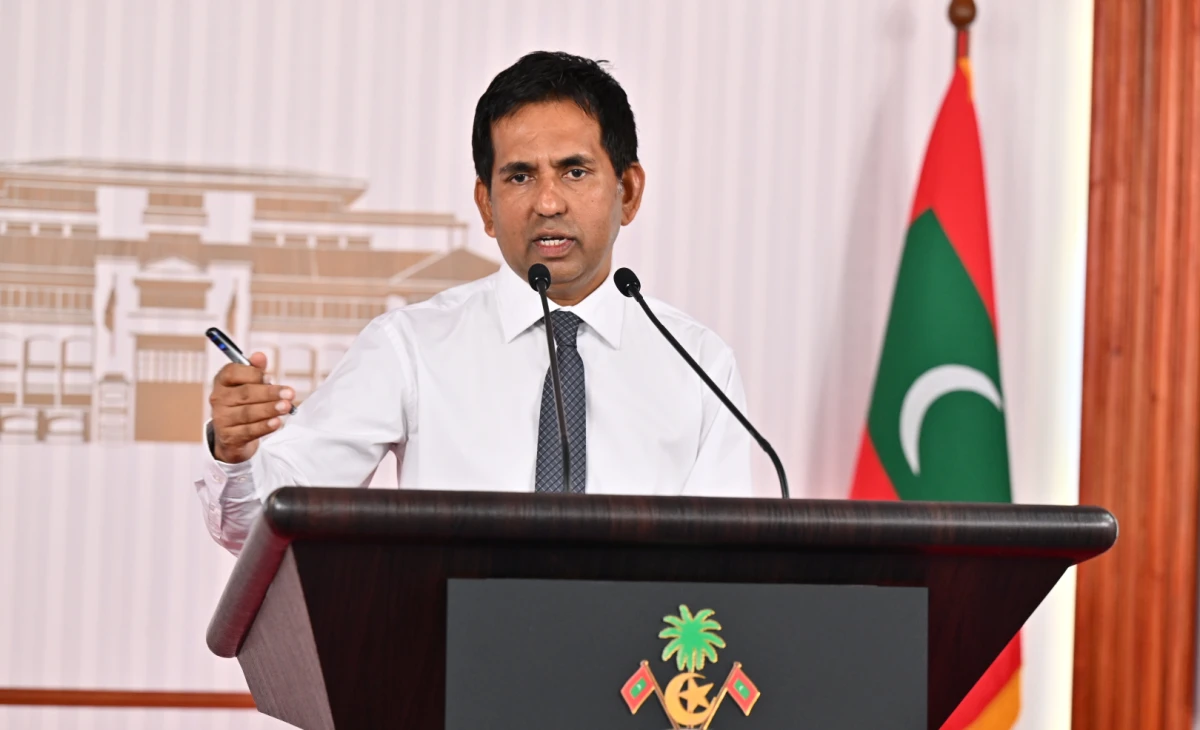
At a press conference at the President’s Office on 3 March, Economic Development and Trade Minister Mohamed Saeed set out a series of measures the government says will secure the country’s food supply and keep prices stable despite global uncertainty. He said the Cabinet had instructed the Ministry of Economic Development and Trade to ensure that essential goods remain available at affordable rates across all islands.
A central part of the strategy is strengthening the supply chain. STO will continue supplying islands with populations under 3,000 through local agents, while larger population centres will be served directly.
Saeed said transport and storage capacity are being expanded to support this work. Maldives Ports Limited has arranged duty‑free storage at Kulhudhuffushi Port, with a similar facility now in place in Addu City’s Hithadhoo. He added that special sea routes, known as Anchor, have been designated to keep supplies moving to outer islands even during rough weather or climate‑related disruptions.
Saeed said the government’s updated list of basic food items is based on consumption data from the Consumer Index and the National Bureau of Statistics. It identifies three staple items along with ten fruits and ten vegetables most commonly used in Maldivian households. He noted that since the 1950s, successive administrations had treated rice flour and sugar as core basic commodities. President Muizzu, he said, had expanded the list to reflect changing diets and living standards, ensuring that a wider range of essential foods remains accessible at sustainable prices.
The government will now import 23 categories of basic food items from whichever global market offers the best price at the time. Saeed said this approach allows the state to maintain steady supplies and shield households from sudden price swings. He added that the government is monitoring instability in the Middle East, particularly its impact on oil and gas prices, and is exploring alternative markets while increasing national reserves. “In the worst case scenario, we are prepared to source essential goods from alternative suppliers,” he said.
Turning to foreign currency, Saeed said the government has met all its commitments since taking office and increased the availability of dollars in the formal banking system. Allocations for Hajj and Umrah pilgrims have risen, and the Bank of Maldives is arranging foreign exchange facilities for importers during Ramadan. He said there is no stagnation in dollar availability and that the government is dismantling black‑market practices that had taken hold during earlier shortages.
A new Foreign Exchange Act now requires businesses earning foreign currency to deposit earnings in local banks, with tourism operators declaring per‑tourist income and other businesses depositing a share of foreign‑currency earnings once they cross the USD 15 million threshold.
Saeed also highlighted the government’s efforts to diversify the economy under the Special Economic Zones framework. For the first time since the SEZ Act was passed, investment licences have been issued, including for renewable‑energy projects and a financial centre. A new Visitor Economy Council has been established to broaden tourism offerings by integrating cultural heritage sites, natural destinations and halal‑tourism concepts. Dedicated islands have been allocated for resort development under this model.
He described the sustainable township project launched in Noonu Atoll as the largest foreign investment in the country’s history, valued at around USD 800 million. The township will include healthcare and education facilities, renewable‑energy systems covering most of its consumption and agricultural production aimed at reducing food imports. Real‑estate regulations within the township are designed to be competitive with markets in the Middle East and Asia. A new Foreign Investment Act has replaced what Saeed called an outdated framework, and an Investment Protection and Promotion Agreement with the UAE now offers additional security to investors.
Saeed ended the briefing by saying the government had used its super‑majority in the Majlis to advance measures that strengthen the economy, improve public services and raise living standards. He said the administration’s mandate had allowed it to move quickly on key national priorities, pointing to achievements such as the launch of air‑ambulance services, the introduction of wide‑body aircraft to the national carrier, new tobacco‑control measures and the expansion of RTL ferry routes to islands that previously lacked regular transport links. He added that foreign‑exchange reserves had risen above USD 1 billion and the Sovereign Development Fund had grown from USD 2 million to USD 300 million, which he described as evidence that the government’s decisions were producing tangible results.
“This is a government making full use of its mandate,” Saeed said. “We will not use the Majlis to weaken the economy.”