News Desk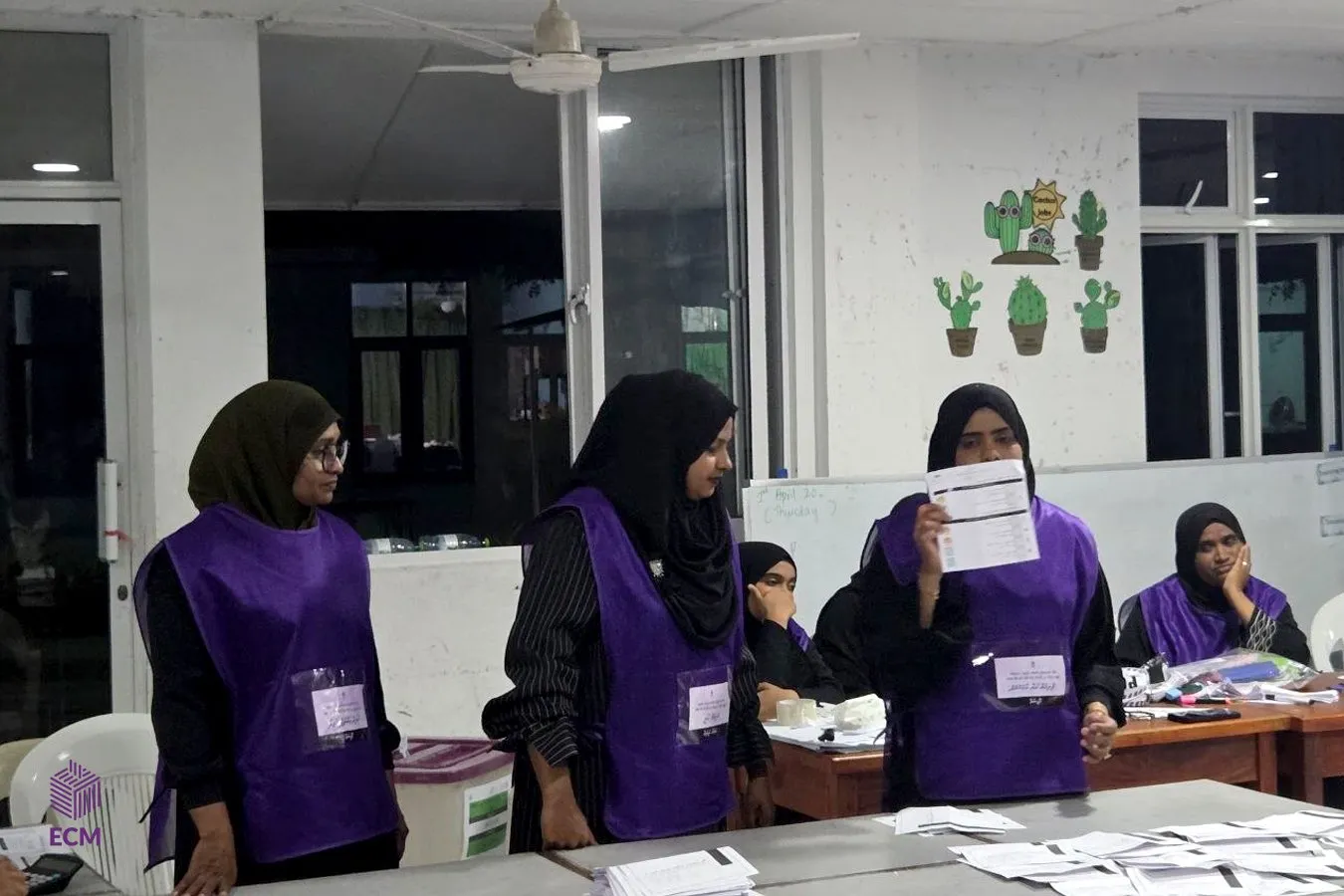
The Elections Commission has stated that the local council, Women’s Development Committee and referendum held in the Maldives on Saturday were conducted in a free and fair manner.
Announcing the official results, Commission President Mohamed Zahid reported that 215,346 out of 294,576 eligible voters had cast their ballots, marking the highest turnout recorded for council and women’s committee elections.
“The elections held on Saturday, April 4, 2026, were free and fair,” Zahid said.
Provisional results have now been announced, with a second round scheduled in constituencies where candidates received an equal number of votes. Zahid confirmed that the second round will take place on Saturday.
A total of 1,626 observers from Maldivian NGOs and 38 international observers monitored the polls. In addition, 4,021 candidate representatives and 3,275 monitors participated in the process.
The National Complaints Bureau received 170 complaints related to the elections. Zahid said the Commission is reviewing the cases in line with legal procedures, and individuals who remain unsatisfied with the outcomes have the right to appeal to the High Court within 14 days.
The government has suffered a significant political setback in this election, following defeats in several key constituencies and the national referendum on synchronising presidential and parliamentary election cycles. The scale of the outcome is notable given the administration’s extensive resources, political standing and highly visible campaign efforts.
The results come at a time when allegations had been raised regarding the use of state resources during the campaign period, including last‑minute job creation and the distribution of financial or material benefits. Despite these factors, voters ultimately did not support the government’s position, indicating a shift in public sentiment.
In the days leading up to the vote, several decisions had notable fiscal implications. Rent for 6,000 flats was waived for a two‑year period, which is expected to reduce revenue from housing projects financed through large loans. A significant number of jobs were also created shortly before the election, many with brief application windows. These developments contributed to additional pressure on an already constrained economic environment.
Sudden project announcements and door‑to‑door engagement by the president and ministers contributed to shaping public perceptions of the administration’s approach during the campaign period.
Final results show a strong performance by the opposition MDP, which secured most mayoral and council seats in major cities, including Malé, Addu, Fuvahmulah, Thinadhoo and Kulhudhuffushi. The outcome in Malé is particularly notable given the president’s previous tenure as mayor and the government’s expectation of strong support in the capital.
The referendum also delivered a clear rejection of the government’s proposal to shorten the current parliamentary term and synchronise the two national elections. While the election saw a high turnout and earlier indicators suggested support for the administration, the final results pointed to voters reassessing their preferences, signalling a broader shift in sentiment.
Legal experts offered differing interpretations of the outcome. One lawyer noted that the results should not be viewed as a straightforward victory for the opposition, saying the voters who rejected the government’s proposal were “largely people within the system who expect the administration to perform.” He added that these voters “will give a fair verdict if the government delivers in the coming two years.”
A seasoned political observer said the outcome may be read as placing the president in a more constrained position for the remainder of the term, describing it as “a situation that limits political room and demands careful navigation.”
Observers note that the administration’s focus on consolidating political authority, rather than implementing reforms, contributed to public dissatisfaction.
During this period, the administration emphasised maintaining political stability and economic continuity despite the broader fiscal challenges facing the country. Officials highlighted efforts to keep the market steady and ensure that public needs remained central to policy decisions. Despite this, the overall budget composition continued to shift, with recurrent expenditure taking a larger share and capital investment declining.
Some within the PNC have also expressed concern about the decision to hold the referendum alongside the local council elections. According to these activists, combining the two votes energised the opposition and contributed to the unusually high turnout, effectively elevating the election to the level of a national contest. They argue that had the referendum been held separately, the outcome of the local elections might have been different.
Progress on development pledges has also been limited.
The government sought to draw lessons from previous administrations, aiming to avoid practices that could weaken its governance and instead placing greater emphasis on addressing housing challenges. Despite these efforts, concerns remained regarding recruitment practices and the perceived distance of some officials from public concerns. The election results reflected these sentiments, offering a clear message to the administration at the ballot box.
The message from voters is clear. The public has signalled dissatisfaction with rhetoric, high expenditure and politically driven decisions, expressing a preference for long‑term development over short‑term measures.
With new mayors and councillors taking office, the government is now expected to reassess its policies and work constructively with local leaders. The outcome reflects a politically aware electorate and a call for a more results‑oriented approach to governance.