News Desk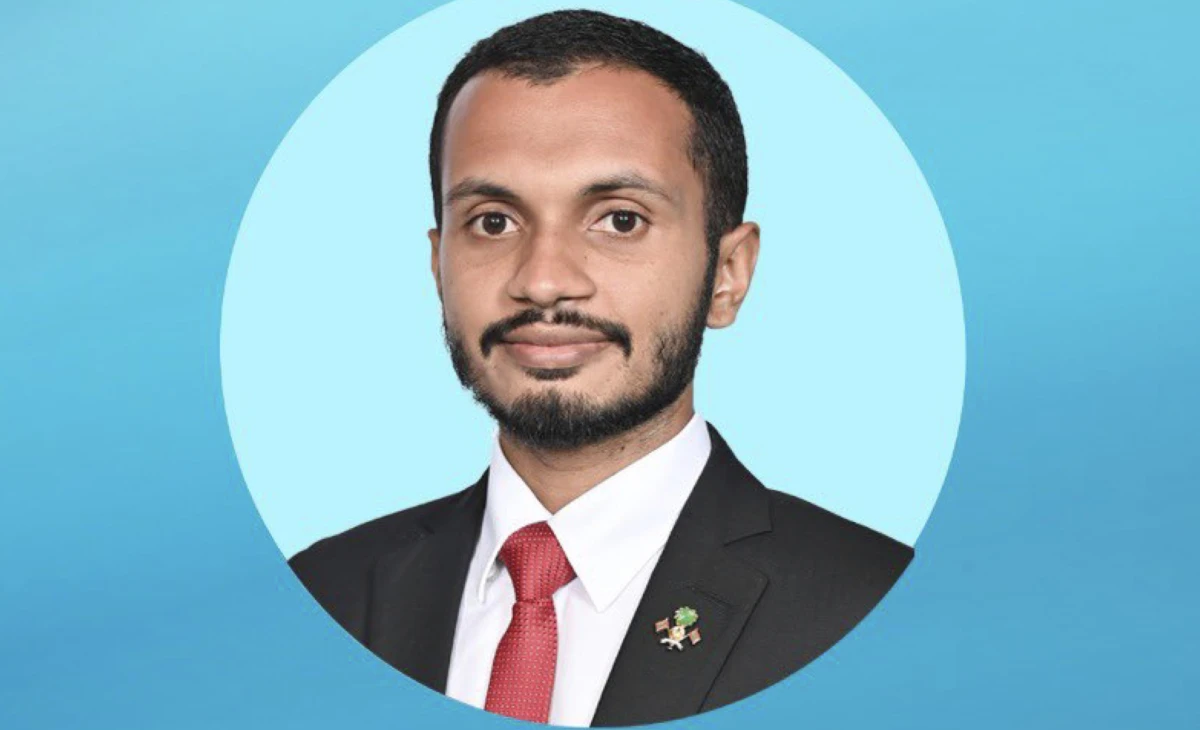
MALÉ – When President Mohamed Muizzu’s government took office in November 2023, few Maldivians outside political circles had heard the name Mohamed Firzul Abdulla Khaleel. Within weeks, his face – calm, precise, rarely rattled – had become a fixture of the government’s press briefings. Two and a half years later, his appointment this week as Managing Director of the Maldives Hajj Corporation marks not a departure from public life but the latest step in one of the more closely watched rises in the new political establishment.
A voice for the transition
Firzul’s public profile was forged in the chaos of a change of government. In October 2023, as President-elect Muizzu’s team assembled a transitional administration to take over from the outgoing government, Firzul was named spokesperson for the Transitional Committee – the body tasked with managing the handover of state affairs. It was a role that demanded fluency in both the mechanics of government and the temperament to face reporters daily during one of the most closely scrutinised transfers of power in the Maldives’ recent history.
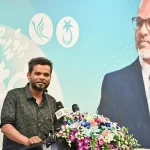
That early assignment set the template for what followed. Once Muizzu was sworn in, Firzul was retained as Under Secretary for Public Policy at the President’s Office, a position from which he became one of the administration’s most visible communicators. He briefed journalists on the government’s “Hafuthaa 14″ roadmap – the new administration’s 14-week list of pledges – and delivered some of its most politically sensitive disclosures, including a November 2023 briefing that put a precise figure on the number of Indian military personnel stationed in the Maldives, breaking down their roles across helicopter and aircraft operations. It was characteristic of his style: a technocrat’s command of detail deployed in service of a government eager to draw a sharp line under its predecessor’s foreign policy.
He also spoke for the government on the country’s long-running maritime boundary dispute, delivering a statement on the Maldives’ efforts to reopen the question of Mauritius’s case before the International Tribunal for the Law of the Sea – a dispute with implications for the Maldives’ exclusive economic zone.
From podium to policy
Firzul’s portfolio widened as the administration settled in. He went on to serve as Under Secretary for Presidential Affairs and was later listed among the President’s Office’s deputy ministers, reflecting a shift from pure communications work toward a broader policymaking role. Alongside his government posts, he took on the position of spokesperson for the People’s National Congress, the party at the centre of the ruling coalition, giving him a rare dual perch: articulating both the government’s official line and the governing party’s political messaging.
Legal foundations
Firzul’s academic background is in Islamic jurisprudence and law. He holds a degree in Sharia and Law from Al-Azhar University in Cairo, one of the Sunni Muslim world’s oldest and most prestigious centres of religious and legal scholarship. That training in law and policymaking has often been cited by colleagues as the basis for his methodical, detail-heavy approach to public communication – a contrast to the more combative style of some of his contemporaries in Maldivian politics.
A new posting, a familiar pattern
His appointment this week to lead the Maldives Hajj Corporation – the state enterprise responsible for organising Hajj and Umrah pilgrimages for Maldivian citizens – was confirmed by the Privatisation and Corporatisation Board, which named him both Managing Director and a board member. The move places him atop an institution with a direct bearing on the lives of thousands of Maldivian pilgrims each year, and one that sits at the intersection of religious affairs and state administration.
It is, in one sense, a departure from the front-facing spokesman role that made him a familiar figure to Maldivian television audiences. But it fits a broader pattern in Firzul’s career: successive postings that trade visibility for responsibility, each one drawing on the reputation for procedural rigour he built during the government’s turbulent early weeks.
Whether the Hajj Corporation posting is a stepping stone to a more senior political role, or a natural home for a lawyer with a taste for institutional detail, is a question Malé’s political class will be watching closely. For a young official who rose alongside Muizzu’s government from its very first day, the answer may say as much about the administration’s plans as it does about Firzul himself.