 News Desk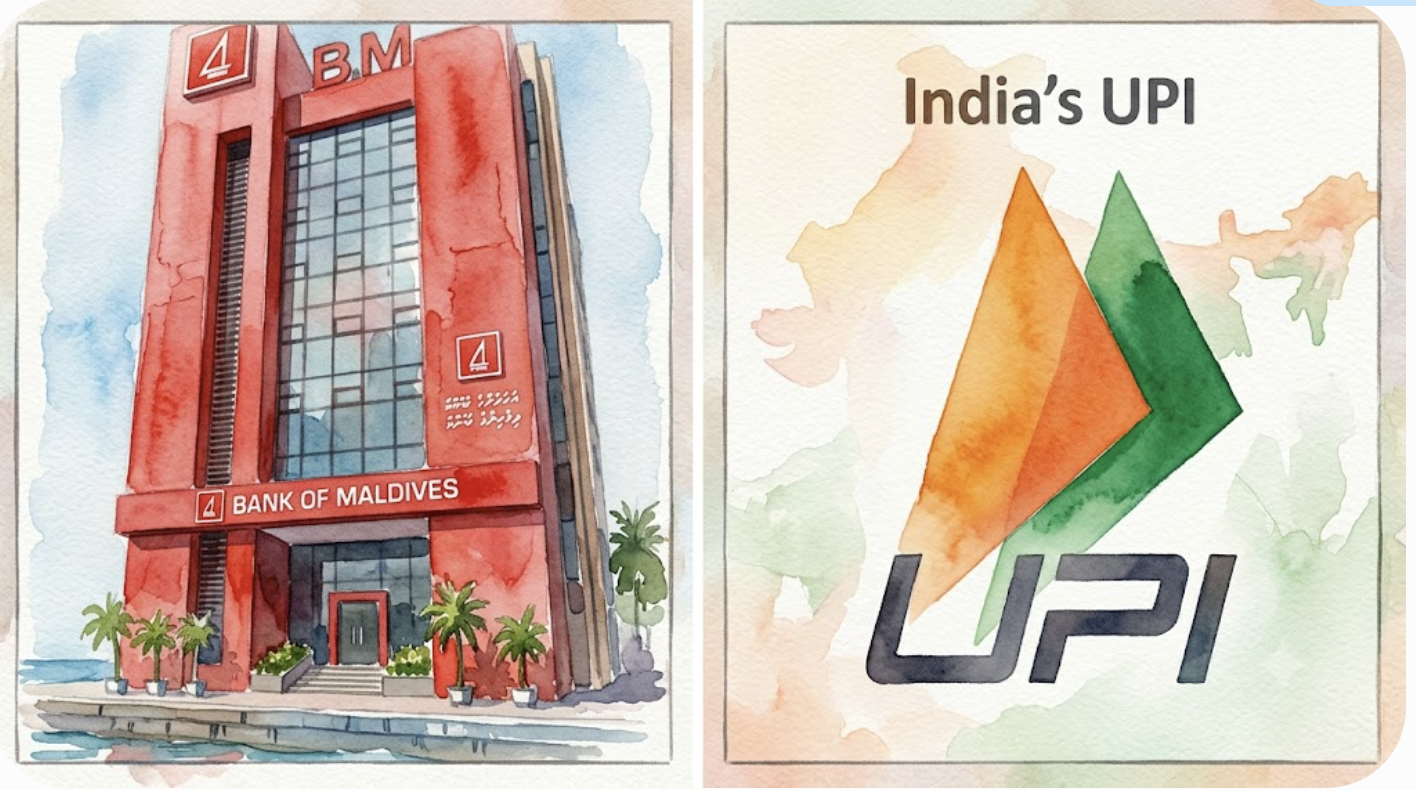
MALÉ — For thousands of Maldivians navigating medical treatment, higher education, or long-term living arrangements across the subcontinent—as well as the sizeable Indian expatriate population residing in the Maldives—sending money to India has long been a grueling chore.
For years, remittances meant standing in cramped, jostling queues outside bank counters such as the State Bank of India in Malé, or relying on informal hawala networks burdened by steep charges and multi-day delays.
That system gave way to digital infrastructure last month following the integration of the Maldives’ instant payment network, “Favara”, with India’s Unified Payments Interface (UPI). The bilateral link transforms cross-border money transfers into a real-time process, settling transactions in seconds.
However, the user experience currently hinges on individual retail banks updating their digital platforms. A survey of the country’s two main lenders reveals a sharp contrast in readiness:
Bank of Maldives (BML) has fully integrated the feature into its mobile and internet banking platforms. BML customers can execute person-to-person transfers directly to an Indian recipient’s UPI identifier, with funds debited in Maldivian Rufiyaa and credited instantly in Indian Rupees. The bank’s automated assistant provides step-by-step operational instructions upon first query.
Conversely, Maldives Islamic Bank (MIB) has faced implementation hurdles. Although the institution posted an announcement on its website, its mobile application has yet to deploy the functional update. Online customer queries route through an AI assistant that cycles in repetitive loops without resolving technical queries, while telephone support lines leave callers stranded on hold indefinitely.
How the Pipeline Works: Mechanics and Security
Despite the speed of transaction execution, security protocol remains central to the platform’s design. The Favara-UPI architecture incorporates automated, multi-layered checks to prevent fraud and human error.
Before funds leave a sender’s account, automated algorithms screen the transfer against international sanction lists and anti-fraud databases. The platform then utilizes a global real-time protocol known as “Name Check,” which cross-references the recipient’s UPI ID and displays the verified account holder’s full name on the sender’s screen for confirmation.
Prior to final authorization, users receive a full summary itemizing:
- The recipient’s verified legal name.
- The live exchange rate.
- Applicable bank processing fees.
Upon confirmation, participating local banks draw from pre-funded correspondent accounts in India to bypass batch-clearing procedures, allowing immediate credit into the recipient’s bank account.
Operational Limits and Next Steps
The initial operational phase restricts transfers exclusively to Person-to-Person (P2P) remittances, catering primarily to medical care, school fees, and domestic family maintenance.
Individual monthly transfer caps are currently set to the equivalent of USD 250 (approximately 24,000 Indian Rupees) per bank customer.
Financial authorities in Malé and New Delhi are preparing the next expansion phase, which will introduce “Merchant QR Payments”. Once operational, the feature will permit Maldivian travellers in India to pay merchants, hospitals, and transport services directly via QR code scanning, bypassing foreign currency exchange desks altogether.