News Desk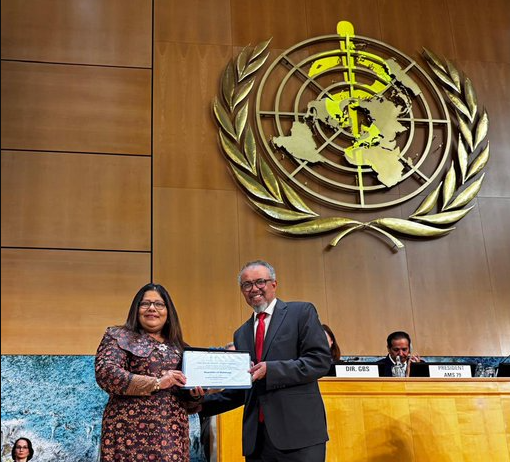
GENEVA/MALE — The World Health Organization has awarded the Maldives a plaque recognising it as the first country in the world to eliminate mother-to-child transmission of HIV, syphilis and hepatitis B simultaneously, a milestone announced at the 79th World Health Assembly in Geneva.
The plaque was presented to Minister of Health, Family and Welfare Geela Ali at the assembly. The recognition places the Maldives in rare company globally and marks the completion of a process that began with a narrower achievement in 2019, when the WHO confirmed the Maldives had already eliminated mother-to-child transmission of HIV and syphilis. No cases of HIV or congenital syphilis were reported in newborns in the years that followed. The addition of hepatitis B to that list now completes the triple elimination.
The achievement rests on three pillars that have been built up over roughly a decade. Universal screening during pregnancy, a healthcare coverage rate exceeding 95 percent for pregnant women, and a high uptake of the hepatitis B birth-dose vaccine together closed the transmission pathways that in many countries remain stubbornly open. The Maldives’ distributed island health system, which reaches communities across a dispersed archipelago, proved central to maintaining those coverage rates outside the capital.
The WHO, UNICEF and rural health workers across the islands contributed to the effort alongside national health agencies. Digital health platforms and strengthened disease monitoring systems were also cited as part of what made sustained progress possible.
For a small island nation with limited resources and a geographically challenging health infrastructure, eliminating all three diseases in tandem is a significant public health accomplishment. Many larger and wealthier countries have not managed it with even one.
The recognition is expected to position the Maldives as a reference point for other small island developing states working to strengthen maternal and child health systems.