News Desk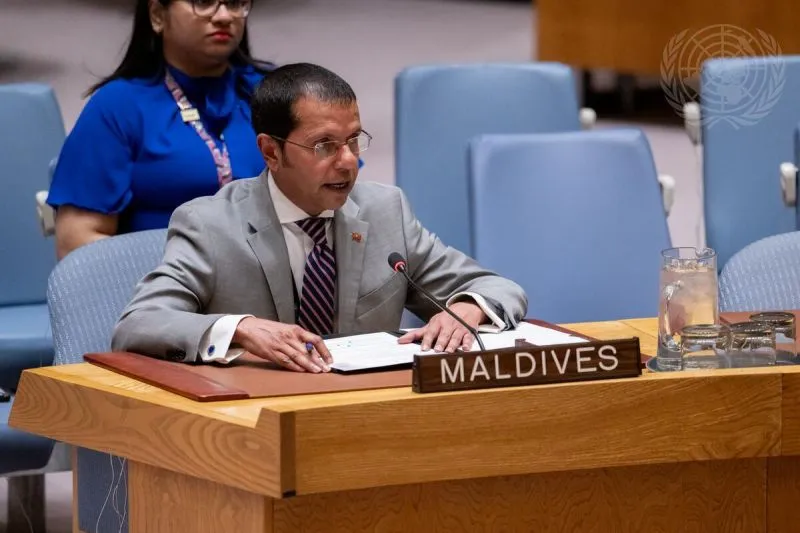
The Maldives has told the UN Security Council that instability in key shipping lanes is translating into higher costs and supply pressures across small island economies. Ambassador Ali Naseer Mohamed said the impact of attacks on commercial vessels is felt far from the Strait of Hormuz, showing up in fuel prices, food costs and delays that strain daily life in island nations.
He was speaking at a debate convened by Bahrain on the safety and protection of maritime routes. He said the Maldives depends on open sea lanes for fuel, food and basic security. Any disruption in major waterways moves quickly into freight charges and household budgets.
He singled out the Strait of Hormuz as an area of particular concern. He said the Maldives supports safe and unimpeded navigation in line with international law. He warned that prolonged instability would affect trade, energy flows and wider global security.
He noted the concerns of Bahrain, Kuwait, Oman, Qatar, Saudi Arabia and the United Arab Emirates, whose economies rely on uninterrupted passage through Hormuz.
He outlined three principles for collective action. Respect international law, including UNCLOS. Strengthen cooperation, information sharing and capacity building. Treat the protection of maritime routes as a shared responsibility.
He said small island developing states face wide ocean spaces and limited resources. The Maldives is expanding surveillance across its Exclusive Economic Zone, but he said no country can manage these risks alone. National Security Advisor Ibrahim Latheef said the intervention was timely and welcomed the ambassador’s remarks.
The wider geopolitical drivers behind the current instability in West Asia were not addressed in the statement. Much of the tension in and around the Strait of Hormuz is linked, analysts say, to United States and Israeli military actions and to state actors whose policies have contributed to the escalation. Iran, for its part, signed the UN Convention on the Law of the Sea but never ratified it. Its long standing position is that transit through the Strait must respect its territorial sovereignty. The United States, which has not signed or ratified UNCLOS, operates outside the treaty framework while maintaining a significant military presence in the region. This legal and political gap has shaped decades of friction.
For small island states, the consequences of these disputes are not abstract. Any disruption to world peace and global trade is absorbed first by economies with narrow buffers, high import dependence and limited room to manoeuvre.