 News Desk
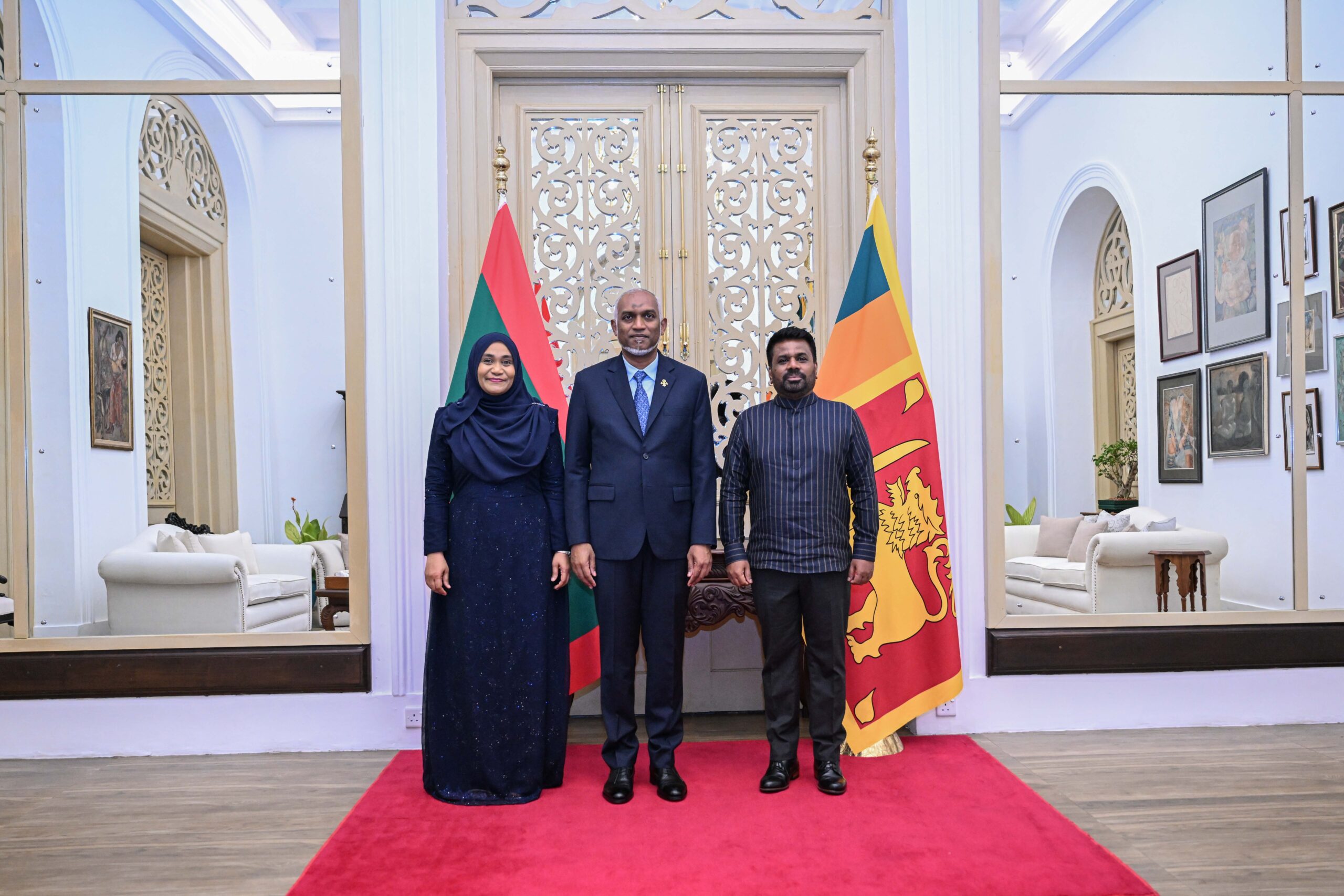
During his two major public appearances in Colombo, President Dr Mohamed Muizzu presented a carefully layered message that blended sentiment, strategy, and regional positioning. The State Banquet speech offered emotional depth and historical framing, while the joint press statement shifted to policy, implementation, and economic direction. Together, they reveal a leader intent on resetting the Maldives–Sri Lanka relationship on both symbolic and practical grounds.
In the banquet address, President Muizzu leaned heavily on imagery and shared memory. He described Sri Lanka as “a country that has long been a part of the Maldivian story” and spoke of ties that “flow gently and deeply, like the ocean that connects our two island homes.”
The language was intimate, almost literary, designed to emphasise continuity and trust. He reminded his hosts that Maldivians have long viewed Sri Lanka “as a close neighbour, who feels like family,” a line that signals a desire to anchor the relationship in people rather than politics.
The ocean served as the central metaphor. President Muizzu said it “does not divide us. It unites us,” a formulation that positions the Indian Ocean as a shared strategic space rather than a contested one. He used the same imagery to frame climate vulnerability, calling climate change “the defining challenge of our time” and urging both countries to turn “shared vulnerability into shared strength.” The banquet speech was, in essence, a narrative exercise: a retelling of the relationship as one built on resilience, cultural familiarity, and mutual care.
The press statement earlier in the day shifted tone. It was more structured, more transactional, and aimed at signalling deliverables. Where the banquet speech leaned on metaphor and sentiment, the morning remarks focused on mechanisms, timelines, and institutional cooperation.
President Muizzu described the discussions as “highly productive” and said the visit marked “the beginning of a renewed and forward-looking partnership.” The phrasing was deliberate. It suggested that the relationship is entering a phase defined less by symbolism and more by coordinated policy work.
The list of sectors he highlighted was broad, but the emphasis on implementation stood out. “Our focus now is clear: delivery and implementation,” he said.
That line was not ornamental. It was intended to reassure both audiences that the agreements signed would not remain on paper. The Maldives has often been criticised for slow follow-through in bilateral projects, and the statement appeared designed to counter that perception.
Economic cooperation occupied the centre of the press event. President Muizzu spoke of “expanding trade and investment flows” and “unlocking new business opportunities,” but he also raised the issue of the trade imbalance, noting the need for a relationship that is “more balanced, equitable, and mutually beneficial.”
The mention of a possible Bank of Maldives presence in Sri Lanka and the introduction of premium Maldivian fisheries products were the clearest examples of concrete proposals. They also pointed to a strategy of widening Maldivian economic footprints in the region.
The press statement also placed heavier weight on security cooperation. President Muizzu reaffirmed commitments to maritime security and capacity-building, noting that the Maldives “deeply values Sri Lanka’s continued support through joint exercises, training, and capacity-building.”
The language was careful. It framed security cooperation as stabilising and technical rather than geopolitical. This is consistent with the Maldives’ recent effort to present its defence partnerships as practical rather than strategic.
Climate change appeared in both speeches, but the press statement framed it in institutional terms. President Muizzu called it an “existential threat” and reaffirmed commitments to “stronger international advocacy” and “collective action for climate resilience.”
The shift from poetic imagery in the banquet speech to policy language in the press event reflected the dual nature of the visit. One speech was designed to reassure. The other was designed to outline work.
Taken together, the two speeches reveal a diplomatic strategy that blends narrative and negotiation. President Muizzu used the banquet to reaffirm emotional ties and cultural familiarity. He used the press conference to set expectations for the next phase of cooperation. The contrast was intentional. It allowed him to speak to history in one setting and to future obligations in another.
The combined message was that the Maldives wants a relationship with Sri Lanka that is rooted in people and culture, but also one that is measurable, structured, and aligned with national priorities.
The ocean imagery, the references to shared resilience, and the repeated emphasis on youth and education created a sense of continuity. The detailed list of agreements and the call for implementation created a sense of direction.
In Colombo, President Muizzu presented a partnership that is both sentimental and strategic. The two speeches, taken together, suggest that he sees value in honouring the past while negotiating the future.