News Desk
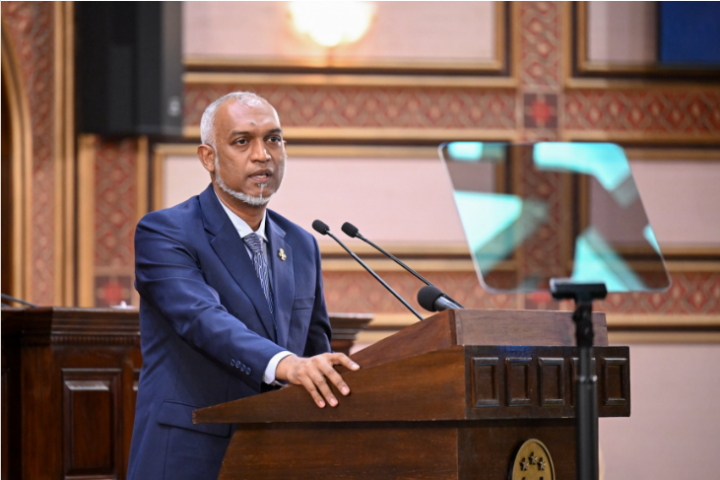
At a recent gathering with Gen Z audiences, President Dr. Mohamed Muizzu did something unusual for Maldivian political culture: he talked about character building. Not policy metrics, not infrastructure, not the usual partisan score‑keeping — but the moral scaffolding he believes young people need in an age of globalized pressures.
He joked lightly about the grey in his hair, confirming that he has not yet reached his 50s, and insisted that this proximity to youth gives him a sense of what they are going through. “I feel what you feel,” he told the room, framing the conversation as part of a broader effort to shape youth‑focused policies that, he said, will be unveiled soon.
But the heart of his remarks was about something deeper. He described looking at national issues through what he called a “nationalistic and religious lens,” warning that the erosion of national identity — and the casual normalization of behaviours once considered serious moral boundaries — could leave young people unmoored.
“People say, ‘It’s okay… this isn’t bad… this is cool,’” he said, arguing that such attitudes simplify long‑held principles until they lose meaning. Some youths, he suggested, have drifted far enough that “bringing them back to the fold of faith” has become necessary. He recalled discussing these same concerns as a student, long before entering politics.
It was a striking moment: a sitting president speaking not about political rivalry but about the moral formation of the next generation. And it raises a larger question — one that Maldivian politics has rarely confronted with seriousness. If character matters, can political parties actually build it?
A System Built on Parties That Don’t Build People
Political parties, in theory, are supposed to do more than win elections. They aggregate interests, articulate ideologies, and cultivate future leaders. In practice, Maldivian parties — young, fluid, and often personality‑driven — have struggled to do any of these consistently.
Memberships rise and fall with election cycles. Ideological lines blur. Patronage networks overshadow policy debates. And alliances shift so frequently that voters often treat parties as temporary vehicles rather than long‑term homes for political identity.
The result is a system where parties rarely invest in the slow, unglamorous work of shaping young leaders — the kind of work that produces ideological conviction, ethical grounding, and policy competence.
If the president is calling for character building, the question becomes: who is responsible for it? And can parties, as they currently operate, shoulder that responsibility?

What Character Building Could Look Like in a Party System
Around the world, parties that endure — whether in democracies or single‑party states — do so by cultivating internal cultures that outlast individual leaders. The methods differ, but the underlying logic is the same: political stability requires political education.
If character matters, can political parties actually build it? Internationally, the answer has long been yes — but only when parties treat political education as a core function rather than an afterthought.
In Germany, youth academies run by major parties teach ethics, governance, and debate.
In India, the BJP relies on the RSS to instill ideological discipline long before members enter electoral politics.
In the United States, youth wings, campus chapters, and think‑tank fellowships form a steady pipeline of politically literate activists.
Singapore’s ruling party, the PAP, identifies promising young professionals early and channels them through leadership programs that emphasize public ethics, technocratic competence, and national service.
South Korea’s major parties run policy institutes and youth wings that train organizers in democratic activism — a legacy of the country’s pro‑democracy movement.
Japan’s Liberal Democratic Party, which has governed for most of the postwar era, cultivates future leaders through factional mentorship, party schools, and long apprenticeships under senior politicians.
And in China, the Communist Party’s cadre schools and youth organizations create a rigid, lifelong system of political socialization.
The models vary, but the message is consistent: leadership is cultivated, not improvised. Character is not left to chance — it is built through institutions.
For a small, fast‑changing democracy like the Maldives, several approaches stand out.
- Party Schools and Internal Training
Many countries maintain party academies where young members learn ideology, governance, ethics, and political history. These programs create cadres who understand not just what the party stands for, but why.
In the Maldives, such structures are minimal or ad hoc. Parties could formalize them — not as indoctrination centres, but as civic‑education hubs that teach policy literacy, democratic norms, and ethical leadership.
- Youth Wings With Real Power
Most Maldivian parties have youth wings, but few treat them as incubators for future leadership. Giving young members real responsibilities — policy drafting, community programs, internal debates — would build both competence and loyalty.
- Clear Ideological Anchors
A party that cannot articulate its worldview cannot shape the worldview of its members. Ideological clarity is not rigidity; it is coherence. Without it, young members drift, and parties become vehicles for personal ambition rather than collective purpose.
- Grassroots Engagement Beyond Elections
Character is shaped in community, not in campaign headquarters. Parties that invest in year‑round civic work — literacy programs, environmental projects, social services — create leaders who understand the country beyond the capital.
- Ethical Codes and Accountability
If parties want to talk about character, they must model it. Transparent internal rules, consequences for misconduct, and a culture that rewards integrity over loyalty would send a stronger message than any speech.

President Muizzu’s remarks land at a time when Maldivian politics is recalibrating. Old alliances are being re‑stitched. New factions are emerging. Voters, especially young ones, are increasingly sceptical of political theatrics.
In that environment, a conversation about character — however framed — is not insignificant. But speeches alone cannot build the next generation of leaders. Parties must decide whether they want to be machines for winning elections or institutions that shape citizens.
The Maldives has never lacked young talent. What it has lacked is a political culture willing to cultivate it.
If parties take that challenge seriously, the president’s comments may mark the beginning of a broader shift. If not, they will fade into the long archive of political speeches that diagnose problems without building the structures needed to solve them.