News Desk
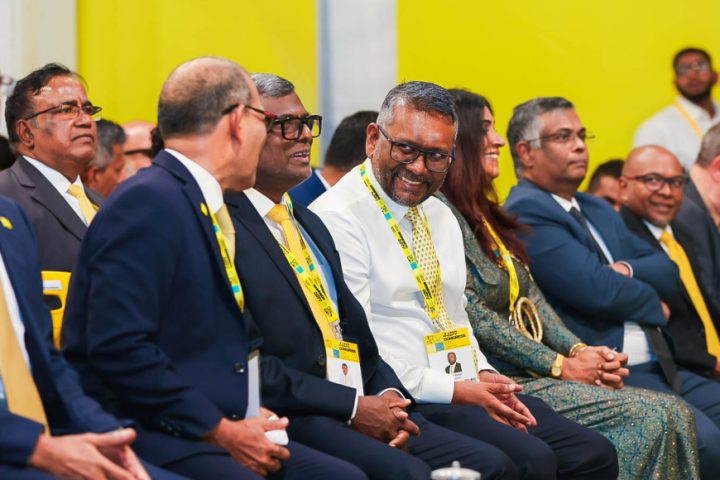
MALÉ, Maldives — On November 3, former President Maumoon Abdul Gayoom received a special commemorative shield from President Dr. Mohamed Muizzu. The ceremony, held as part of the official Victory Day 2025 event at the Social Centre in Malé, honoured Gayoom for his role in preserving national sovereignty on the fateful day of Nov. 3, 1988.
Thirty-seven years ago, as dawn broke over the island nation, a band of armed Sri Lankan mercenaries, aided by a handful of Maldivians, slipped ashore in the capital with their sights set on toppling Gayoom’s government. The attackers were fighters from Sri Lanka’s People’s Liberation Organisation of Tamil Eelam, a splinter group hardened by years of separatist conflict. They had been hired by a cabal of Maldivian exiles led by businessman Abdullah Luthufee and his associate Ahmed “Sagaru” Nasir, who dreamed of seizing power.

Gunfire echoed through the narrow streets of Malé. Hostages were taken, blood was shed, the state broadcaster was silenced, and the president himself went into hiding. His pleas for help echoed across the region, reaching distant capitals.
It was a moment that could have unravelled the Maldives, a nation of scattered atolls that had lived in relative peace, largely oblivious to the rivalries that simmered across the Indian Ocean. Help did not come from Washington or London, but from across the sea in New Delhi. India, under Prime Minister Rajiv Gandhi, answered the call within hours, launching Operation Cactus, a decisive intervention that restored order and cemented a bond of trust still felt today.
The crisis unfolded with ruthless speed. At around 4:15 a.m. on Nov. 3, 1988, some 80 to 100 PLOTE fighters armed with automatic rifles, rocket launchers and grenades disembarked from two chartered speedboats disguised as fishing trawlers. They quickly overwhelmed the lightly armed Maldivian National Security Service, storming key sites including the presidential office, the defence ministry and the power station. Radio and television transmissions went dark as chaos gripped the city of 60,000.
Among those who resisted was Hussain Adam, a young lance corporal barely out of his teens. Stationed at the locked gates of the National Security Service headquarters, he returned fire with fierce determination until his ammunition ran out. He was struck down in the relentless barrage that followed, remembered as a martyr of that day.
Nineteen Maldivians lost their lives, including civilians, security personnel and government officials.
Gayoom, who had already survived coup attempts in 1980 and 1983, evaded capture by slipping into a neighbour’s home. From there, he dispatched urgent appeals to allies including the United States, Britain, Pakistan, Sri Lanka and India.
Responses trickled in slowly. The United States and Britain cited logistical hurdles. Pakistan declined. Sri Lanka, mired in its own civil war, could offer little. But India moved with precision. By midmorning, PM Gandhi had approved the intervention, drawing on intelligence from the Research and Analysis Wing that traced the threat’s origins. Within two hours, the Indian Army’s 50th Independent Parachute Brigade in Agra was on alert. By 3:30 p.m., two Soviet-built Ilyushin Il-76 transport planes carrying 500 paratroopers from the 6th Battalion, the 17th Parachute Field Regiment and artillery units thundered off the runway, flying 1,200 miles nonstop to Hulhulé Island, the airport just outside Malé.
Brigadier Farouk F. C. Bulsara, commanding the force, coordinated from the air as fighters provided cover. Touching down amid sporadic gunfire, the paratroopers fanned out with practiced efficiency, securing the airport and pushing into Malé. They linked up with Maldivian forces and cornered the intruders, who scattered in disarray. By nightfall, the mercenaries’ grip had collapsed, and the president was escorted safely back to his residence.

The operation’s finale played out at sea. In the aftermath of the failed coup, PLOTE mercenaries hijacked the freighter MV Progress Light and fled toward Sri Lanka with Maldivian hostages aboard, including high-profile figures. The situation turned deadly when the gunmen executed captives and dumped their bodies overboard. The Indian Navy responded swiftly. The frigate INS Godavari, already patrolling nearby, shadowed the vessel. Marine Commandos, precursors to today’s MARCOS, boarded the ship, capturing 27 mercenaries and rescuing the remaining hostages.
Operation Cactus concluded in less than 24 hours, a testament to India’s military readiness and its commitment to regional stability. At Gayoom’s request, troops lingered briefly, aiding interrogations—many of the captives spoke only Tamil—and bolstering security as the capital steadied itself. The intervention drew quiet praise from Washington. President Ronald Reagan called it “an immense contribution to regional security.” It also underscored India’s role as a bulwark against adventurism in South Asia, deterring the possibility of foreign bases or meddling that might have followed a successful coup.
For the Maldives, the rescue was more than a military intervention. It was a lifeline to sovereignty. Gayoom, who ruled until 2008, often invoked the episode as a cornerstone of bilateral ties. Even today, Maldivian leaders across the political spectrum speak of it with gratitude, a rare bipartisan touchstone amid occasional frictions.
India’s aid helped professionalize the islands’ defence, transforming the old security service into a modern force. Economically, too, the partnership deepened. Indian expertise in radar systems, disaster response and other fields has since improved the Maldives’ capacity to withstand the challenges.