News Desk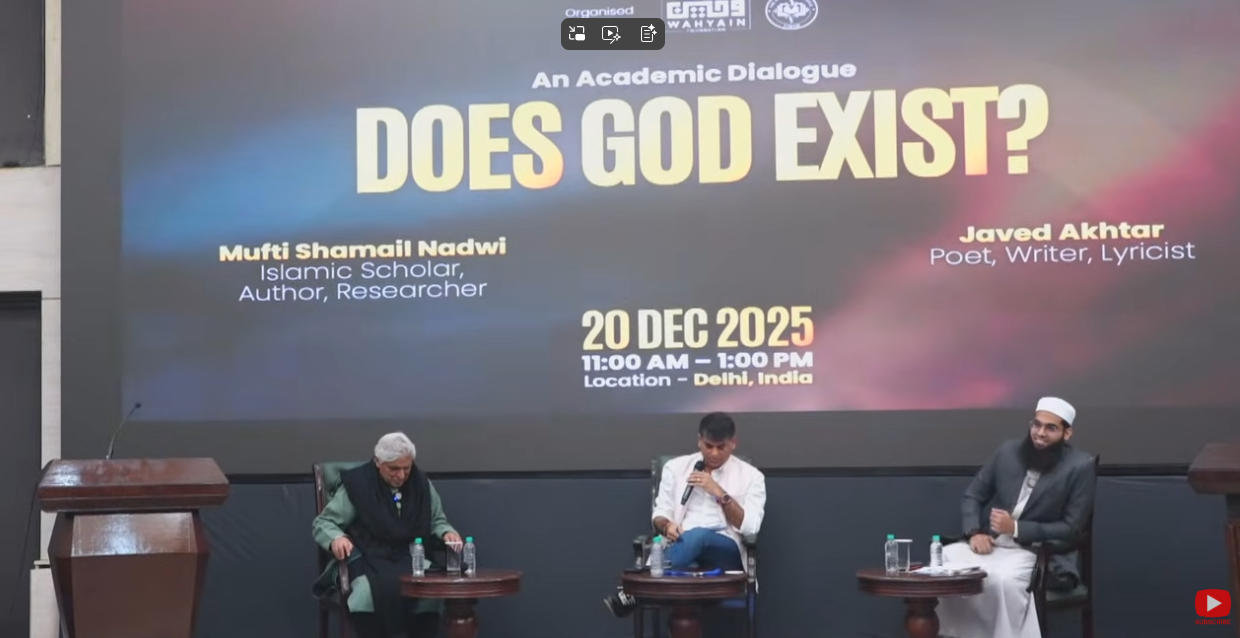
NEW DELHI — In a quiet hall at the Constitution Club, just a stone’s throw from India’s Parliament, two men sat across from each other to argue a question as old as humanity itself: Does God exist?
On one side was Javed Akhtar, 79, the legendary Bollywood lyricist and fierce advocate for secular rationalism, himself a product of the intellectual culture of Aligarh Muslim University. On the other was Mufti Shamail Nadwi, a young, tech-savvy Islamic scholar from Kolkata. For two hours, the air was thick not with the usual shouting matches of Indian cable news, but with the heavy weight of logic, philosophy, and a shared respect for each other in the search for truth.
The debate, moderated by The Lallantop’s Saurabh Dwivedi, felt like a throwback to a more intellectual era. At a time when religious discourse in India is often explosive, this was a surgical exchange—a “battle of the brains” that sought to answer whether the universe is a grand design or a beautiful accident.
The Metal Detector and the Plastic
The debate began with a question of tools. Mufti Shamail Nadwi opened with a provocative metaphor. To use science to look for God, he argued, is like using a metal detector to find a piece of plastic.
“If the detector doesn’t beep, it doesn’t mean the plastic isn’t there,” the Mufti told the audience. “You are simply using the wrong tool.” He argued that while science explains how things work, only logic and “Aqal” (intellect) can explain why we are here. To him, the complexity of the universe is a definitive fingerprint of a Creator.
The Problem of the Suffering Child
When it was Javed Akhtar’s turn, he didn’t reach for physics textbooks. He reached for the human heart. His argument was rooted in the “Problem of Evil”—a classic philosophical challenge to the idea of an all-powerful, merciful God.
Akhtar’s voice, familiar to millions through his poetry, turned sharp as he questioned the utility of prayer. “People pray for a job or a green card for their son,” Akhtar noted. “But 45,000 children die [in conflicts and disasters] and God does not stop it. If He has the department of daily intervention open for small favours, why is it closed for the innocent?”
For Akhtar, the existence of suffering isn’t just a tragedy; it’s a logical proof that if a God exists, He is either not all-powerful or not all-merciful.
The Grand Exam
The Mufti countered by framing human life as a “test.” In his view, the world is a temporary classroom where humans have “Free Will”. If God intervened to stop every bad thing, he argued, the “exam” of life would lose its meaning. Justice, he insisted, is not always found in this life, but is guaranteed in the next.
Why It Matters
The debate wasn’t just about religion; it was about the role of doubt in modern society. Akhtar represents a growing segment of urban India that looks to science and human rights as their “religion.” The Mufti represents a faith grounded in a profound scholarly legacy, applying modern logic to explain the timeless relevance of its scripture.
As the lights dimmed and the crowd filed out into the New Delhi evening, no one had “won” in the traditional sense. Akhtar remained an atheist; the Mufti remained a believer. But in a world increasingly defined by “us vs. them,” the sight of a rationalist and an Islamic scholar sharing a meal afterward was perhaps the most profound answer of the day.
In the end, the debate proved that while we may never agree on whether God exists, we can still agree on the importance of asking the question.
The Details
- Location: Constitution Club of India, New Delhi.
- Participants: Javed Akhtar (Poet/Rationalist) vs. Mufti Shamail Nadwi (Founder, Wahyain Foundation).
- Format: A structured, four-round debate with rebuttals and audience Q&A.
- Full Video: Watch the debate here
Brief Backgrounds
Javed Akhtar — Poet, Lyricist, Public Intellectual
Javed Akhtar is one of India’s most celebrated literary figures, known for his work as a poet, screenwriter, and lyricist. Emerging from the Progressive Writers’ Movement tradition, he helped shape modern Indian cinema through landmark scripts in the 1970s and 1980s, and later became a prominent voice in public debates on secularism, rationalism, and social reform. His public persona blends literary sophistication with outspoken commentary on religion, politics, and culture.
Mufti Shamail Nadwi — Islamic Scholar and Public Debater
Mufti Shamail Nadwi is a trained Islamic scholar associated with the Nadwatul Ulama of Lucknow, known for its emphasis on Islamic sciences and engagement with contemporary issues. He has gained a following for presenting Islamic theology in modern public forums, often addressing questions of faith, philosophy, and ethics. His style combines traditional scholarship with a calm, structured approach to debate.
Snapshot: Indian Muslims and Their Intellectual Contributions
Indian Muslims—over 200 million people—form one of the world’s largest Muslim populations, carrying a civilizational legacy that stretches back more than a millennium. Their intellectual output spans theology, philosophy, literature, science, politics, and the arts, creating one of the richest cultural tapestries in South Asia.
In the realm of classical scholarship, India produced towering Islamic thinkers such as Shah Waliullah Dehlavi, Ahmed Sirhindi, and Abul Hasan Ali Nadwi, whose works shaped Islamic thought across the region and continue to influence scholarship today. Institutions like Darul Uloom Deoband and Nadwatul Ulama emerged as global centres of Islamic learning, attracting students and scholars from across the Muslim world.
In literature and poetry, Indian Muslims made contributions that transformed the subcontinent’s cultural landscape. Urdu poetry—through figures like Mir, Ghalib, Daagh Dehlvi, and Hali—became one of South Asia’s greatest intellectual exports, while Indian Muslim writers enriched modern religious and literary discourse in Urdu, Arabic, Hindi, and English.
Indian Muslim thinkers also played a defining role in philosophy and political thought. Figures such as Maulana Azad and Hamid Dalwai shaped debates on nationalism, identity, reform, and modernity, and their ideas continue to inform contemporary discussions on secularism, pluralism, and the role of religion in public life.
In science, education, and reform, the community’s contributions have been equally significant. From APJ Abdul Kalam’s pioneering work in aerospace science to Sir Syed Ahmed Khan’s transformative educational reforms, Indian Muslims have been central to the country’s scientific and institutional development. The Aligarh Movement, in particular, modernized Muslim education and produced generations of scholars and professionals.
Today, the intellectual landscape of Indian Muslims is remarkably diverse. Traditional scholars engage with modern questions of ethics, law, and theology; writers and journalists shape public discourse; academics contribute research across history, sociology, law, and political science; and artists, filmmakers, and poets continue a centuries-old cultural tradition that remains vibrant and evolving.
Despite social and political pressures, the community continues to generate vibrant intellectual work—rooted in a long civilizational memory yet responsive to contemporary realities.