News Desk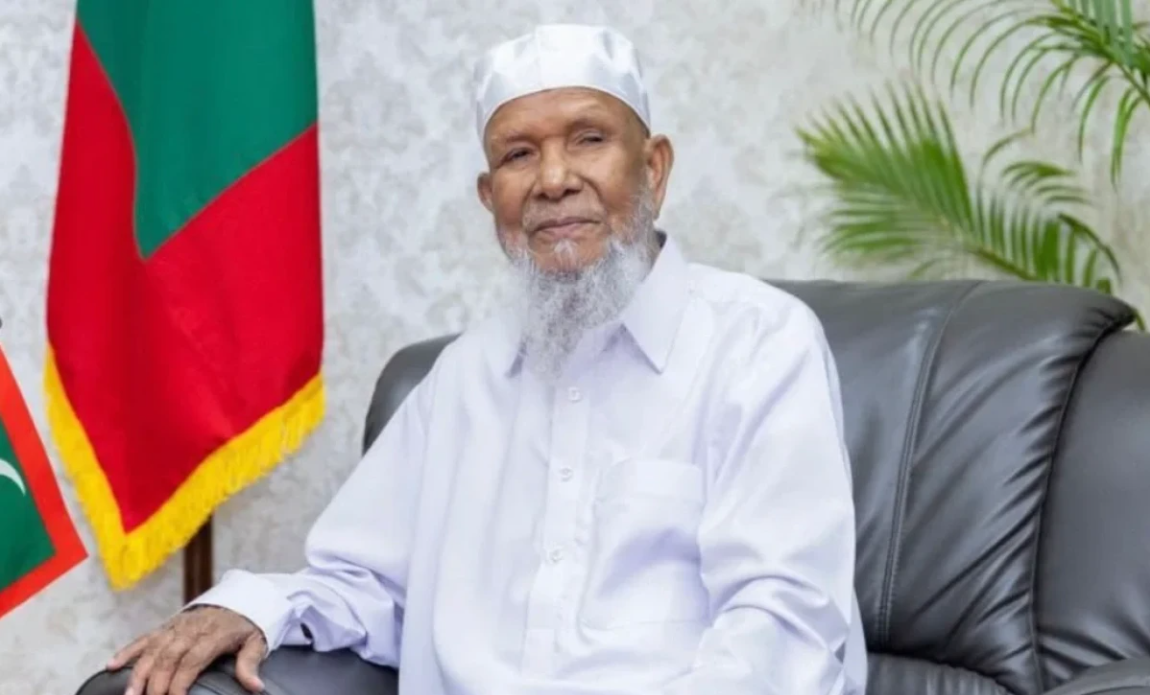
MALE’, – In the collective memory of the Maldivian nation, the passing of religeous scholar Ismail Mohamed does not merely mark the loss of an individual; it signifies the end of an era. For over half a century, the late scholar served as a cornerstone of Islamic education, leaving behind a legacy that has fundamentally altered the archipelago’s religious and intellectual landscape.
From the remote islands where he first pursued his studies to the hallowed halls of international academia, Sheikh Ismail’s life was defined by an unyielding commitment to knowledge and a pioneering spirit that refused to be deterred by the limitations of his time.
Born in Dhaalu Meedhoo, Sheikh Ismail’s pursuit of education began in an era when such aspirations were fraught with logistical and financial hurdles. His early promise, however, was undeniable. As one of the few students selected from the atolls to relocate to the capital for formal schooling, he found his footing at Dharul-Iqama, the state-run boarding hall for atoll students, and subsequently at Majeediyya School, one of the nation’s oldest and most prestigious institutions.
Though he began his professional life in the Ministry of Trade-the engine of the nation’s fledgling economy-the classroom proved to be his true vocation. Whether at Majeediyya or Aminiya School, he became a transformative presence, mentoring a generation of students whose lives were irrevocably shaped by his pedagogical dedication.
Driven by a thirst for deeper religious insight, Sheikh Ismail embarked on an arduous path to higher education. Self-funded and undeterred by the immense financial challenges of the time, he first honed his foundations in Arabic and Islamic studies at Jamia Darussalam. Oomerabad, in Tamil Nadu, India.
He spent some time before heading to Madina for further education at Salafiyya School in Faisalabad, Pakistan. His pursuit eventually led him to the Islamic University of Madina in Saudi Arabia. His admission there was a historic milestone: Sheikh Ismail was the first Maldivian student to attend the university, an achievement that remains etched in the annals of the nation’s educational history. Specialising in Dawah and Usul-ud-Din (Principles of Religion), he also pursued advanced studies in teaching methodology. This dual expertise in theology and pedagogy allowed him to become not merely a religious scholar, but a sophisticated educator capable of disseminating Islamic knowledge with modern, structured precision.
Sheikh Ismail’s impact was not confined to his personal scholarship. He became a conduit for others, facilitating opportunities for over 100 Maldivian students to study in Pakistan. Many of the prominent religious scholars serving in the Maldives today trace their foundations back to his vision.
Upon his return to the Maldives, he established Thayiba School. With the support of the late philanthropist Dhihdhoo Ibrahim Kaleyfaanu (DIK), the school-situated on the grounds of the Masjid Hassan Izzuddin-became the primary intellectual nursery for dozens of scholars who would eventually carry the mantle of religious education across the islands.
Beyond academia, the Sheikh left an indelible mark on the Maldivian judiciary. As a judge, he was revered for a level of integrity that often transcended political pressure. Perhaps the most defining moment of his judicial career was his refusal to issue a ruling he deemed contrary to justice, despite pressure to align with state interests. Upon realising that the demands of his position conflicted with his conscience and his fear of God, he chose to resign. This act of moral courage remains a profound testament to the ethical rigour he demanded of himself and his peers.
A writer, Sheikh Ismail authored over 40 books covering Aqeedah (islamic creed), Fiqh (jurisprudence), and Islamic ethics. At the time of his passing, he was engaged in the monumental task of translating the Tafsir al-Muyassar-a prestigious Quranic commentary from the King Fahd Complex-into Dhivehi. With half of the work already approved for publication by the Ministry of Islamic Affairs, his contributions continue to serve as a vital resource for Maldivians seeking to engage with the Quran in their mother tongue.
His life’s work was formally recognised when he became the recipient of the first honorary doctorate ever conferred by Maldives Islamic University, a fitting tribute to his lifelong service.
Even in his final days, Sheikh Ismail’s focus remained on service; he was overseeing the construction of a mosque in Hulhumale-a final act of his ongoing charity.
As the nation reflects on his life, it is clear that Sheikh Ismail Mohamed left behind more than just books and buildings. He left a blueprint for the modern Maldivian scholar: one defined by intellectual depth, uncompromising integrity, and an enduring commitment to placing the interests of the nation and faith above personal ambition. His legacy is not merely in the past; it is a living history, woven into the educational fabric of every island he helped illuminate.