News Desk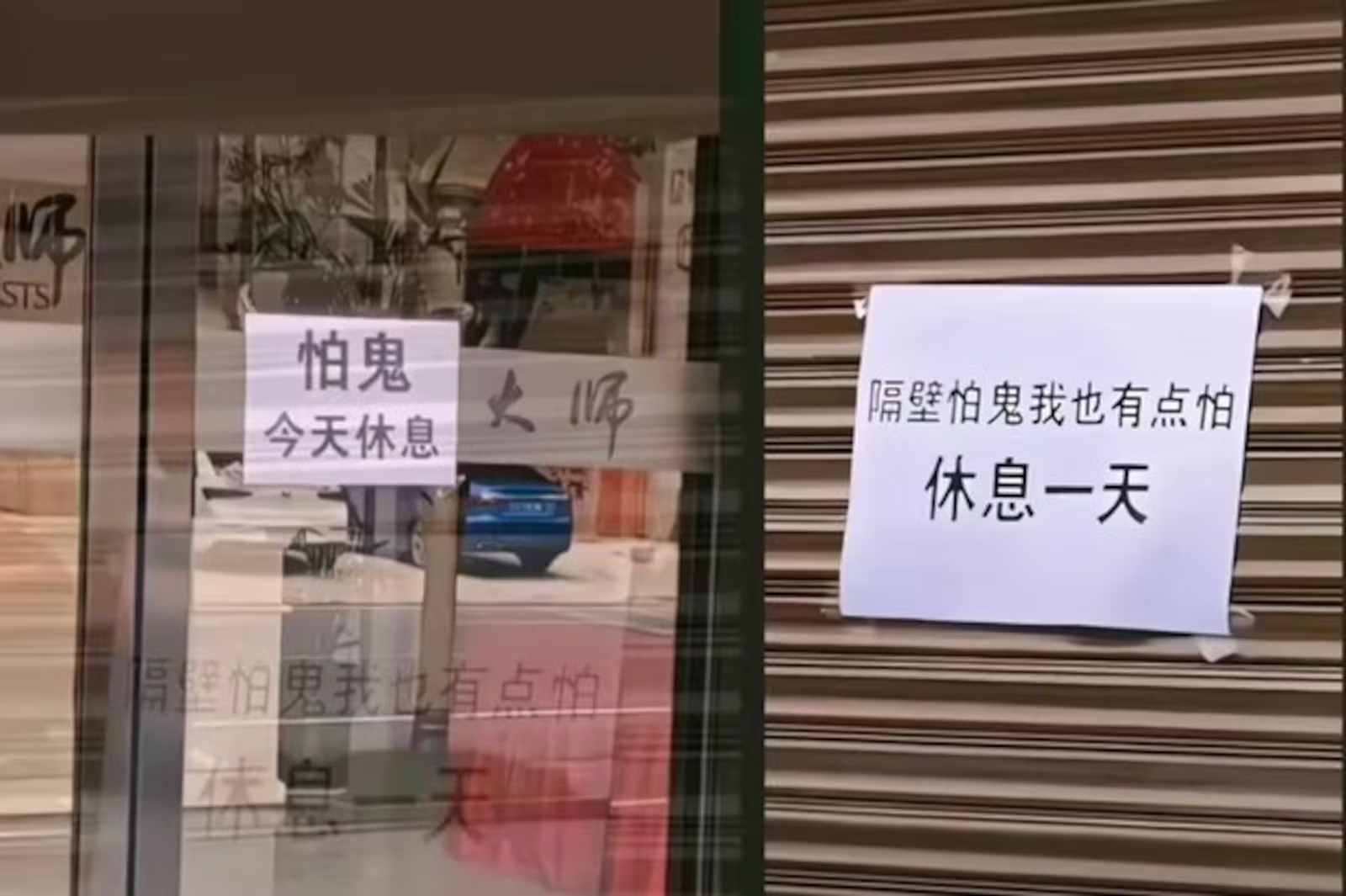
On some Chinese commercial streets, the most conspicuous sign of business activity has recently been its absence. Shutters have come down, restaurants have stopped serving customers, and small shops have remained closed while owners watch for inspection teams. The closures have appeared across several provinces amid intensified checks over product certification, workplace safety, fire prevention, and other regulatory requirements. For many small merchants, the immediate calculation is stark: a day or several days without sales may be less damaging than a fine that could wipe out weeks or months of income.
The phenomenon has been documented most prominently by YesterdayBigcat, an independent platform that tracks protests, labor disputes, and collective incidents in China. It reported that between July 22 and August 4, large-scale closures occurred in nine cities across Jilin, Zhejiang, Jiangsu, and Guangdong, with the latest wave concentrated in Zhejiang. The platform estimated that hundreds of thousands of businesses were involved, although that figure cannot be independently verified. The closures come as Beijing runs several enforcement campaigns simultaneously. A nationwide campaign targeting China Compulsory Certification (CCC) products began in April, while 24 central workplace-safety inspection teams have been deployed across all 31 provincial-level jurisdictions and the Xinjiang Production and Construction Corps. The result is a regulatory environment in which small shopkeepers say they are increasingly uncertain about what inspectors will examine, which standards will apply, and how severe the consequences could be.
The latest reports suggest that the “inspection anxiety” first seen in Heilongjiang has traveled south. YesterdayBigcat recorded closures in Ningbo, Wenzhou, Jinhua, Quzhou, Taizhou, and Shaoxing in Zhejiang, alongside incidents elsewhere in the four provinces. Merchants have reportedly used telephone calls, private chat groups, and other informal networks to warn neighboring businesses when inspection teams are seen nearby. In some cases, shops kept their doors partly open while owners watched the street, while others displayed notices citing family matters or temporary personal circumstances. The response has become sufficiently widespread to acquire its own informal label among some merchants: “avoiding the plague god,” referring sarcastically to inspection teams whose arrival is feared because of potential fines.
This phenomenon had already been reported extensively in Heilongjiang earlier this year, where merchants in numerous counties and cities shut their shops for extended periods between April and June—with one account describing closures continuing for 67 days across parts of the province. The latest spread has raised questions about whether the closures represent isolated local reactions or a broader response to a more aggressive regulatory environment.
One of the most visible enforcement drives involves China’s compulsory product certification system. In April, the State Administration for Market Regulation launched a nationwide special campaign targeting CCC certification, with particular attention to portable chargers, electric bicycles, and gas-burning appliances. Authorities said the campaign would investigate false certification marks, uncertified products, and weaknesses in traceability through the supply chain. This campaign has direct implications for thousands of small retailers because products requiring CCC certification cannot legally be manufactured, sold, imported, or commercially used without meeting relevant requirements. In May, regulators further tightened certification requirements for portable power banks with a new mandatory national standard.
For large manufacturers, compliance can be handled through dedicated legal, technical, and regulatory departments. Small roadside shops operate differently; retailers often depend on wholesalers and manufacturers for certification documents and may carry older inventory purchased under rules that have since changed. That distinction is at the center of complaints from merchants interviewed by The Epoch Times. A Guangdong kitchenware merchant identified as Lin said inspectors found a gas stove without CCC certification and several gas hoses, resulting in a 495 yuan fine. Lin complained that merchants had not received sufficiently clear advance guidance about the new requirements. Her question reflects a broader problem facing small retailers: who ultimately carries responsibility when a product supplied by a manufacturer or distributor turns out to have a certification, labeling, or specification problem?
Other merchants shared similar experiences of operational vulnerability. A Hunan hardware merchant, identified as Wu, said inspectors found a polyethylene water pipe that was slightly thinner than required, though authorities contacted the manufacturer rather than penalizing her. Meanwhile, a Guizhou repair-shop owner, identified as Zhou, reported that inspectors took chargers and portable power banks from his shop for laboratory testing. Zhou noted he had requested CCC certificates from manufacturers to reduce his own exposure, emphasizing how difficult it is for a small countryside shop to survive amid strict enforcement.
The CCC campaign is only one layer of activity. China’s Ministry of Emergency Management announced in June that 24 central workplace-safety inspection teams would enter all 31 provincial-level regions and the Xinjiang Production and Construction Corps during the second and third quarters of 2026. These checks cover major workplace hazards, illegal practices, and regulatory compliance, alongside separate potential checks for fire safety, food handling, gas installations, pricing, weighing equipment, and business records. The overlapping nature of these programs is central to merchant anxiety, as a business may not know which authority is approaching or which part of its operation will draw scrutiny.
These merchant fears come against the backdrop of an unusual admission from China’s own authorities that administrative enforcement against businesses has sometimes been excessive or improper. At a May press conference, the Ministry of Justice stated that a nationwide campaign identified over 66,000 leads involving potentially improper enforcement against enterprises. More than 5,500 cases involving improper fines were handled, and 790 million yuan in fines were addressed. The ministry noted that administrative inspections had fallen by 34 percent year-on-year during the campaign, while the proportion of inspections identifying problems increased by nearly 19 percentage points. While these figures show Beijing recognizes inconsistencies in local enforcement, the new wave of shop closures indicates that the perception of inspection risk remains powerful among small businesses.
For a small shop, regulatory enforcement does not have to result in an actual penalty to cause financial damage. If a business closes for several days, sales disappear while rent, electricity, wages, and other fixed expenses continue. If goods are removed for testing or owners feel forced to replace existing inventory, further costs accumulate. Stories of fines running into tens of thousands of yuan circulate rapidly through local messaging groups, prompting businesses to close before inspection teams even reach their street. This creates a chain reaction where neighbors follow suit, engaging in what YesterdayBigcat founder Lu Yuyu describes as a form of “nonviolent noncooperation.”
The inspection wave is also unfolding against continuing local-government fiscal pressures. The collapse in land-sale revenues and prolonged weakness in the property sector have strained local finances, leading analysts and academic research to point out that debt pressures can create incentives for local authorities to rely more heavily on fine and confiscation revenues. While Beijing’s campaigns specifically target profit-oriented enforcement, this underlying financial environment shapes how merchants interpret incoming inspectors.
Ultimately, China’s authorities are caught between seeking stricter regulatory compliance and attempting to prevent enforcement from disrupting fragile small businesses. What began as widespread closures in northeastern China has now spread to major southern commercial centers, demonstrating the economic consequences of regulatory uncertainty. In a slowing commercial environment, the defensive decision to pull down shutters before inspectors arrive is turning scattered inspection anxiety into a nationwide phenomenon.