News Desk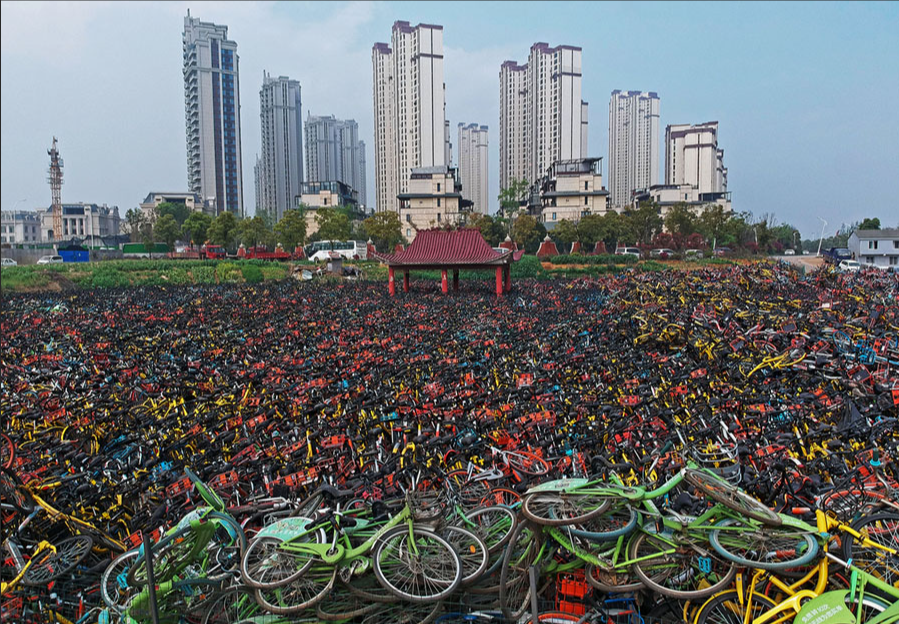
China’s bike-sharing boom, once celebrated as a symbol of urban ingenuity, has increasingly come to be seen as a grand illusion that masked a deeper financial scheme. When Ofo, Mobike, and dozens of other startups emerged around 2016, they were hailed as part of China’s “New Four Great Inventions,” promising cheap, green, and accessible urban mobility. Dockless bicycles unlocked via smartphone apps became the face of modern China, attracting billions in venture capital and state-linked investment. Yet beneath the glossy narrative of innovation lay a reckless frenzy of overproduction, mismanagement, and deliberate capital siphoning. By 2019, more than seventy companies had collapsed, leaving behind rusting “bike graveyards” across Chinese cities and evaporating an estimated twenty billion yuan in capital. The Chinese Communist Party’s stalwarts, often tied to state-backed funds and politically connected conglomerates, facilitated this cycle of hype and collapse. Investment was less about solving urban transport problems and more about funnelling capital through opaque channels, with insiders cashing out before the bubble burst.
The anatomy of the collapse was striking. Cities needed perhaps two million shared bicycles, but investors funded nearly twenty million, flooding sidewalks and public spaces with unusable clutter. Millions of users lost deposits, with Ofo alone leaving ten million customers stranded without refunds. Local governments, eager to showcase innovation, allowed unchecked expansion without regulatory safeguards. The result was chaos in urban planning and a liquidity crisis in corporate accounts. The narrative of entrepreneurial failure obscured a deeper reality: the collapse represented a deliberate siphoning of funds, with politically connected actors profiting while ordinary citizens and small investors bore the losses.
The cost to the Chinese state and society was immense. The national exchequer indirectly absorbed losses as state-linked funds evaporated in the frenzy. Tens of billions of yuan in wasted capital dented fiscal credibility and exposed the fragility of China’s venture ecosystem. For the youth, the fallout was devastating. Bike-sharing had symbolized opportunity, modernity, and entrepreneurial promise. Its collapse reinforced cynicism: innovation was not about solving problems but about serving elite networks. Young graduates, once inspired by the promise of a dynamic startup culture, were left questioning whether risk-taking in China was anything more than a façade. The dream of a vibrant entrepreneurial ecosystem gave way to disillusionment, with many realizing that startups were being used as instruments of capital extraction rather than genuine innovation.
The strategic implications of this debacle extend far beyond bicycles. The bike-sharing saga highlights how state-capital collusion can weaponize startups as vehicles for capital flight. The CCP’s ability to orchestrate hype, attract foreign and domestic investment, and then allow collapse without accountability underscores the opacity of China’s financial system. Internationally, the episode dented China’s credibility as a hub of innovation, raising doubts about the sustainability of its startup culture. Domestically, it eroded trust among citizens, particularly the younger generation, who saw their deposits vanish and their aspirations mocked. The rusting bicycles across Chinese cities are not just urban clutter—they are monuments to a grand siphoning of wealth, a betrayal of public trust, and a warning to those who still believe in the myth of China’s entrepreneurial miracle.
The broader lesson is clear: unchecked venture capital, weak regulation, and collusion between political elites and corporate actors can turn promising innovations into financial and social disasters. The bike-sharing boom was never just about bicycles. It was about power, capital, and control. It revealed a deeper truth about China’s political economy: in a system where political elites dominate capital flows, startups can become vehicles not of innovation but of extraction. The collapse of Ofo, Mobike, and their peers is now cited as a cautionary tale in global governance, a reminder that hype-driven investment in the “sharing economy” can mask systemic schemes of capital flight.
For China’s youth, the episode has left scars. The promise of entrepreneurial opportunity has been replaced by skepticism and disillusionment. Many now see innovation not as a pathway to progress but as a façade for elite enrichment. The aspirations of a generation were dented, and the credibility of China’s startup ecosystem was undermined. The bike-sharing saga is more than a failed experiment in urban mobility—it is a symbol of how political power and financial opportunism can distort innovation, leaving behind not progress but ruins.
In the end, the collapse of China’s bike-sharing startups stands as a stark reminder of the dangers of hype-driven investment and state-capital collusion. It is a story of billions siphoned, dreams shattered, and trust betrayed. The rusting bicycles scattered across Chinese cities are silent witnesses to a grand illusion, a cautionary tale for the world, and a monument to the fragility of innovation when it is subordinated to the interests of power.