News Desk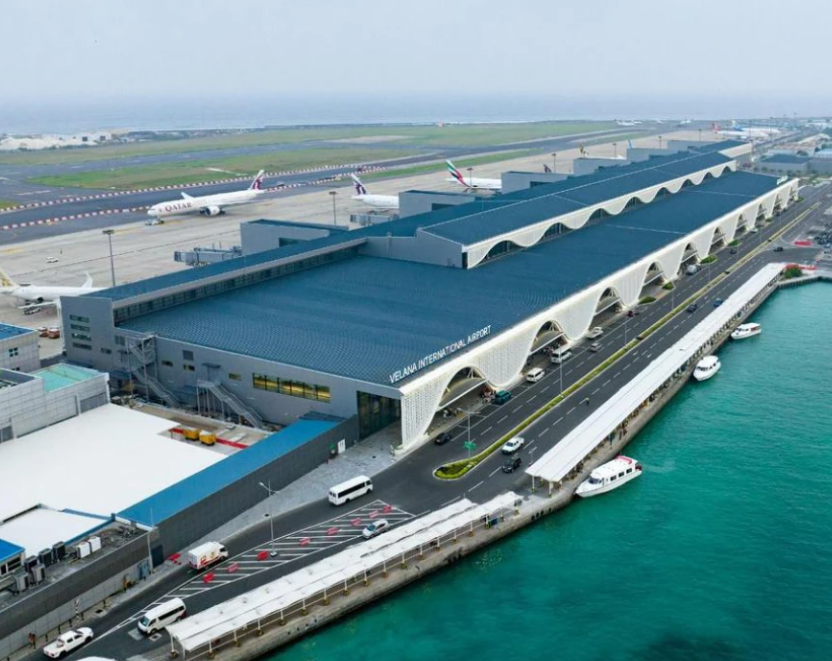
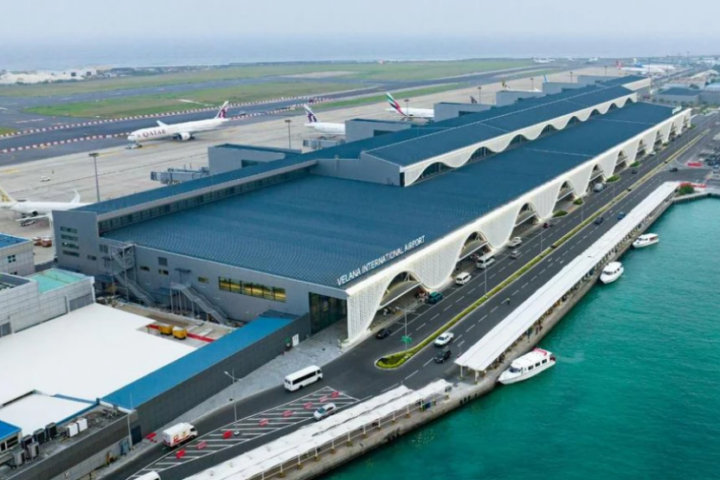
Velana International Airport has significantly expanded its domestic flight capacity, moving operations into the former international terminal and increasing the number of check‑in counters to 27.
The handover was marked at a ceremony on Tuesday attended by senior officials, including Ministers of State, members of the Maldives Airports Company Ltd. (MACL) board, and staff who oversaw the transition.
The relocation to Terminal 2 follows extensive refurbishment carried out by MACL teams. The upgrade brings a substantial increase in passenger handling capacity: the new terminal now offers 27 check‑in counters, up from just eight in the previous domestic facility. Security screening has been expanded to three machines, and six departure gates are now in operation.
The terminal also features separate prayer rooms for men and women, a children’s play area, and three food‑and‑beverage outlets. Arrivals facilities have been redesigned as well, with two baggage belts that are four times the size of those in the former domestic terminal.
The expansion of Terminal 2 comes at a moment when the Maldives is experiencing the highest level of domestic air connectivity in its history. Among small island developing states, the country stands alone in having built an aviation network of this scale and geographic reach. No other island nation of comparable size has developed such an extensive lattice of airports across dispersed atolls.
Today, twenty airports operate across the archipelago, linking remote communities to Malé and to one another in ways that were unimaginable a generation ago. Five airports handle international traffic, while fifteen serve domestic routes, stretching from Hoarafushi in the far north to Gan in the deep south. The network now spans almost the entire length of the country, underscoring aviation’s growing role in national development.
The Maldives’ first dedicated domestic terminal opened in December 2012, inaugurated by President Dr Mohamed Waheed Hassan Manik. Until then, domestic passengers had been processed through the international terminal. The facility was expanded in 2015 to accommodate rising demand as domestic air travel grew across the archipelago.
The country’s new international terminal, a flagship infrastructure project, opened on Independence Day last year. The government borrowed roughly $457 million to complete the development. The Saudi Fund provided the largest share of financing with a $217 million loan, followed by the Kuwait Fund with $100 million and the Abu Dhabi Fund with $90 million. The project is being developed by Saudi Arabia’s Bin Laden Group.