News Desk
MALE’ — The morning coffee had barely cooled when the lament began. It is a familiar grievance in the blocks of Hulhumalé and the cramped apartments of Malé, but on this particular morning, it felt heavier.
“Look at the lifts,” a friend said, gesturing with his cup. “Every morning, I stand there with parents and their kids. The kids aren’t speaking Dhivehi. They’re conversing entirely in English. The parents just nod and reply in English. Are we watching our own language die in front of us?”
As if on cue, the television in the corner of the café blared with the morning news broadcast. It was the 8th of July—the 34th National Writers’ Day—and the screen flashed with the official greetings from the President’s Office.
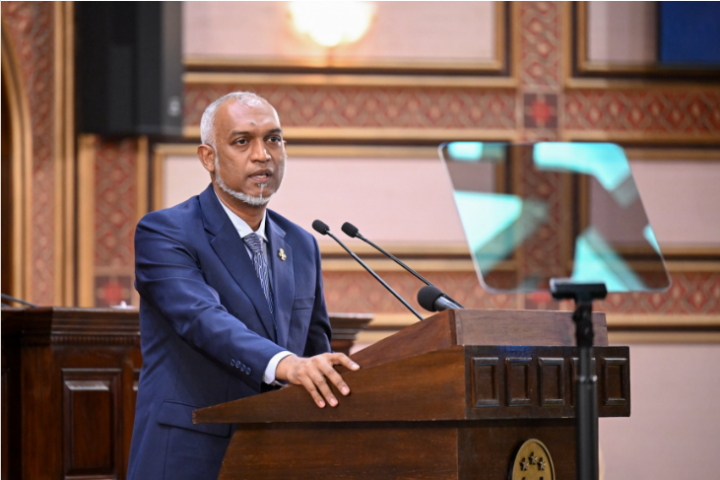
On the social media platform X, President Dr Mohamed Muizzu was urging the nation’s writers to become “agents who spread positive ideals and constructive discourse.” He reminded the public that Islam encourages education and the advancement of writing, advising local authors to focus on “spreading truth, employing polite discourse, and sharing ideas and stories” —reading more like a lecture on media regulation than a celebration of literary freedom! First Lady Sajidha Mohamed joined the chorus, offering prayers for an “ujala” — a bright and prosperous — future for Maldivian literature.
A Promise to Dhivehi: At a Scholar’s School, the Maldives Confronts Its Literary Future
The state ritual of celebrating the written word dates back to 1933, marking the publication of Al-Islaah, the country’s first magazine. But stepping away from the glossy press releases and the televised idealism, a sobering question hangs over the Maldives: Where is the Dhivehi language actually heading?
If one skips the political pleasantries and genuinely asks how much intellectual substance the nation has produced over the past year, the answer is quietly shameful. How many definitive books were translated into Dhivehi? How many seminal works of science, philosophy, or global history were published for a young Maldivian to read in their mother tongue?
The honest answer is next to none.
Instead, the primary intellectual product being manufactured in Dhivehi today is the toxic, relentless political bickering shouted on the floor of the People’s Majlis and echoed across partisan news sites. The language has been reduced to a vehicle for political discourse and character assassination. Had the state cared for its linguistic heritage with the same fierce intensity it reserves for counting votes or mapping out massive land reclamation projects, Dhivehi would possess a thriving life of its own.
Instead, linguistic preservation has been left to bureaucracy. We have an official linguistic academy that occasionally manufactures new Dhivehi words out of thin air—artificial terms that often land on the local ear with a jarring, bombshell-like effect rather than a natural grace. But languages do not thrive by bureaucratic decree; they enrich themselves through organic, intellectual labour.
When it comes to actual publishing, the current administration displays a remarkably narrow vision. The government eagerly directs state funds toward media outlets, but these financial injections are largely designed for government promotion and public relations. Nothing of substance is earmarked for book authoring, creative grants, or translating world literature.
Meanwhile, those sitting comfortably in the cushiony chairs of state cultural institutions seem to have very little idea of what it actually takes to make Dhivehi a living, breathing language for the next generation.
Until the state understands that a language survives because it holds knowledge—not just political speeches—the kids in the lifts will keep speaking English. And no amount of celebratory tweets on the 8th of July will change that.
Ministry Seeks “Researcher” Who Can Barely Spell “Dhivehi,” Offers Fat Paycheck