News Desk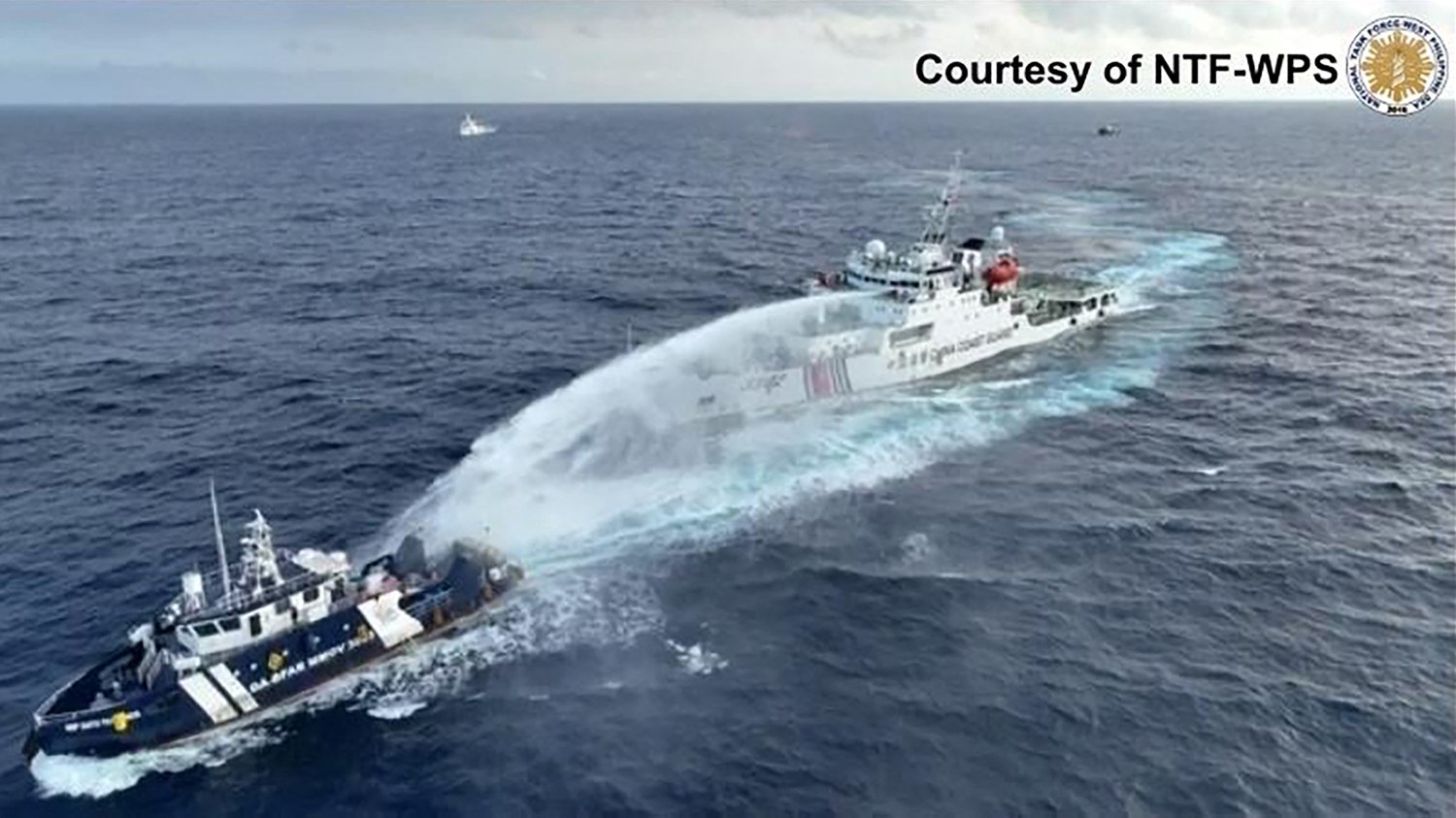
MANILA—China’s aggressive tactics in the contested waters of the West Philippine Sea took a new turn with its deployment of an acoustic weapon against a Philippine vessel, the Philippine Coast Guard (PCG) said, raising fresh concerns over Beijing’s escalating pressure in the region.
According to Commodore Jay Tarriela, a PCG spokesman, the Chinese Coast Guard (CCG) used a Long-Range Acoustic Device (LRAD) to emit high-decibel sound waves at a Philippine vessel, an act he described as both dangerous and provocative. “For the first time, CCG-3103 employed an LRAD to deter a Philippine Coast Guard vessel, blocking its approach,” Tarriela stated in a post on X, formerly Twitter. He warned that the device’s intense sound waves could cause permanent hearing damage, adding another layer to the ongoing maritime standoff.
Crew members aboard the targeted vessel described the noise as excruciating, likening it to an invisible force weaponized to disorient and incapacitate. The use of LRADs—powerful loudspeakers originally developed for long-distance communication—has drawn scrutiny for their dual function as tools of deterrence and potential harm. Often referred to as “sound cannons” or “sonic bullets,” these devices can amplify warnings or, at higher intensities, inflict severe auditory pain and disorientation.
Acoustic weapons exploit the physics of sound waves, manipulating pressure variations to generate frequencies that can be either intensely audible or disturbingly inaudible. The human ear typically detects frequencies between 20 hertz and 20 kilohertz, but devices like the LRAD can operate outside this range, inducing nausea, disorientation, and even cognitive disruptions. While high-frequency sounds tend to fade with age-related hearing loss, low-frequency sounds remain perceptible and can cause distressing physiological effects.
Originally developed in the early 1990s for crowd control, LRAD technology evolved in response to new security challenges. Following the 2000 bombing of the USS Cole, American Technology Corporation—now LRAD Corporation—developed a portable acoustic deterrent capable of repelling threats with overwhelming sound. The device first gained prominence in 2005, when it successfully helped a cruise ship evade a pirate attack off the coast of Somalia. Since then, militaries and law enforcement agencies worldwide have embraced LRADs for their versatility in both communication and coercion.
Despite their widespread use, LRADs remain a subject of controversy. Studies on their long-term health impacts are limited, and some researchers caution that military-backed assessments may downplay the risks. Improper use, inadequate training, or prolonged exposure can lead to severe injuries, including permanent hearing loss. Law enforcement officers operating these devices are strongly advised to wear ear protection, yet even at a recommended safe distance of 10 to 20 meters, unintended harm remains a risk.
“The misuse of LRADs is a real concern, as they can easily be set to dangerously high decibel levels,” Audiology Australia, a professional body for hearing specialists, warned in a recent statement. Earplugs or simple ear-covering measures provide minimal protection against the sheer intensity of sound waves emitted by these devices, which, at close range, can rupture delicate inner ear structures and even damage vital organs.
Since 2016, the deployment of LRADs and other sonic deterrents has increased, with countries including China, Australia, Hong Kong, New Zealand, and the United States integrating them into security operations. The latest incident in the West Philippine Sea underscores how these technologies are reshaping modern conflict, particularly in maritime disputes where non-lethal but aggressive tactics are becoming a tool of statecraft.
The Philippines has repeatedly accused China of employing hostile tactics in the disputed waters, where Beijing claims vast maritime areas in defiance of a 2016 international tribunal ruling that rejected its expansive claims. The introduction of acoustic weapons into this volatile dynamic further complicates the geopolitical calculus, raising concerns about the lengths to which China may go to assert dominance in the region.
For Manila, the LRAD incident is more than just a technical escalation—it is a signal that the contest over the West Philippine Sea is evolving in ways that blur the line between deterrence and direct harm. As geopolitical tensions mount, the use of sound as a weapon could become an increasingly common feature in confrontations over disputed territories, setting a troubling precedent for the future of maritime security.