News Desk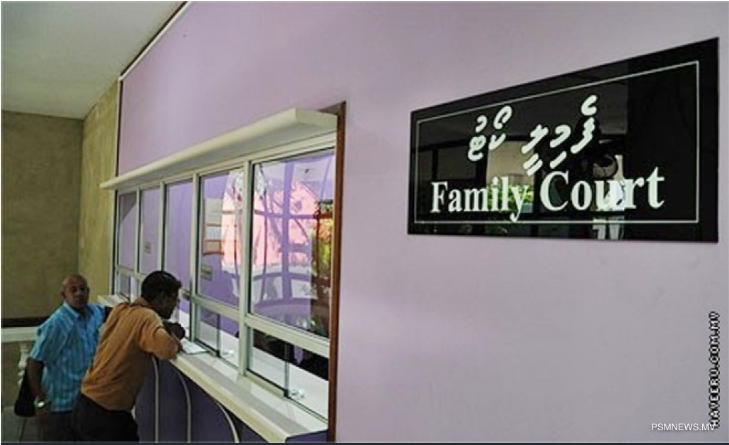
MALE’ — There is something in the air here. Or perhaps it is in the water, the light, the particular quality of silence that settles over a lagoon at dusk. Whatever it is, it bites. It bites the honeymooners who fly eighteen hours to sleep above the ocean in a country that looks like God’s first draft of paradise. And it bites the people who were born here, who grew up on these islands, who have known nothing but this water and this sky their entire lives.
The Maldives does not discriminate when it comes to romance. Foreigner or local, visitor or resident, no adult appears entirely immune to what these 1,200 islands seem to do to the human heart.
The trouble, as a new study released this week makes clear, is what happens after.
One in Twenty-Seven
Every year in the Maldives, divorce touches one in every 27 households. Every single day, on average eight or nine marriages end. Research covering the period from 2020 to 2025, presented at the launch of a National Family Mediation training programme, has laid out the scale of what is happening inside Maldivian families with a clarity that is difficult to ignore.
The marriage rate itself is striking. Thirteen marriages are registered per 1,000 people each year, more than double the global average of around five to six per 1,000, reflecting a long-established pattern of frequent marriage and remarriage in Maldivian society. But set against that figure is a divorce rate of eight to nine per 1,000 people in the same period. For every thirteen people who marry in a year, eight or nine others divorce. That ratio, a divorce rate that nearly matches the marriage rate, places the Maldives among the highest in the world on this measure.
These are not new observations. The Maldives has carried a reputation for high divorce rates for decades, documented by researchers and noted in international comparisons since at least the 1970s. What is different about this week’s study is what it focuses on next: the children.
What Happens to the Children
The research found that children’s wellbeing is directly tied to the experiences of their mothers or primary caregivers. That connection holds before a marriage breaks down, during the breakdown itself, at the moment of separation and in the years that follow. Vulnerability, the study found, does not arrive only at the point of divorce. It arrives in waves, at each stage, and without adequate support it compounds.
The children growing up in this environment are not growing up in the Maldives of the brochures. They are growing up in the Maldives of the inhabited islands, where the average household income is modest, where housing is often overcrowded, where extended family networks that once absorbed the shock of separation have been strained by urbanisation and migration to Male’. They are growing up in a country that sells romance to the world and has not always had the systems in place to support the families that live here.
Health and Family Minister Geela Ali, who launched the research report at the ceremony, said the findings would help identify where problems are heading before they become crises. Chief Justice Abdul Ghanee Mohamed formally started the training programme that follows from the research.
Building a Safety Net
The response the government and its partners have designed is a mediation infrastructure, a system for resolving family disputes outside the courts wherever possible.
The concept of family mediation in the Maldives is not new. It has a history, and that history matters for understanding what this week’s programme is trying to do differently.

The foundations were laid when Judge Sheikh Hassan Saeed was heading the Family Court. He was among the first in the Maldivian judiciary to push seriously for structured mediation as an alternative to adversarial proceedings, drawing directly from the Singapore Family Court model. Singapore had by that point built a regional benchmark for child-centred, non-adversarial family justice, and Hassan Saeed saw in it a template for transforming how the Maldivian court dealt with the families that came before it. The goal was not simply to add a procedural step. It was to change the environment entirely, to make the court feel less like a place where people came to be judged and more like a place where they could be helped.
That effort produced early frameworks and sent genuine ripples through the judicial system. The Supreme Court under Chief Justice Abdulla Saeed later built on that foundation, developing guidance materials with support from the Family Mediation Centre in Bangalore. But over the years that followed, the momentum was uneven. The idea went through cycles of energy and neglect, was reframed under different administrations, and never quite achieved the institutional permanence it needed to take root fully.
What is being launched now is, in one sense, a repackaging of that same impulse, but with more formal structure, more resources and research behind it than earlier iterations had. The current initiative brings together the Ministry of Family, UNICEF, the Family Court and the Department of Judicial Administration under the Child and Family Wellbeing Project.
The logic of mediation remains straightforward. A courtroom is designed to produce winners and losers. Family disputes, particularly those involving children, are rarely improved by being filtered through that process. Mediation offers something different: a structured conversation, facilitated by a trained neutral party, aimed at reaching agreements that work for everyone involved, especially the children caught in the middle.
To build that system at scale, you first need trained mediators. And before that, you need people who can train them. A training of trainers programme with 27 participants is running from 21 to 28 June. Those graduates will go on to develop a wider pool of mediators who will work within the court system to handle family cases before they escalate. Mediator training proper begins in July.
But experts who have worked in this space for years are quick to say that training is only half the effort. The other half is the physical environment in which mediation happens. A mediator trained in de-escalation and child-sensitive communication cannot do their best work in a courtroom that still looks, sounds and feels like a courtroom, with its formal layout, its institutional weight and the unspoken message it sends to every family that walks through the door. The waiting areas, the hearing rooms, the way space is arranged, and the atmosphere it creates all need to change alongside the people being trained to work in it—a necessity made clear by the Family Court’s persistent complaints regarding the constraints and dysfunction of the current facilities.
This was something the Singapore model understood from the beginning. Creating a family-friendly physical environment was never a cosmetic decision. It was a core part of making resolution possible, because people talk differently, listen differently and are more likely to reach agreement when the space around them does not feel like a battlefield. That lesson has not always carried through into how the Maldives has maintained its family justice infrastructure over the years. Between 2019 and 2025, thirteen agreements related to marriage and separation were formally registered, a number that suggests structured frameworks for managing family breakdown are still finding their footing here, even after years of trying.
The Paradox at the Heart of It
There is something quietly uncomfortable about the gap between the Maldives the world comes to visit and the Maldives that its own people inhabit. The country has become extraordinarily good at selling a version of itself, one of natural grace and romantic possibility, that is entirely real in some respects and entirely incomplete in others.
The overwater villas are real. The sunsets are real. The silence of a lagoon at dawn is real. But so is the statistic that one in every 27 homes is affected by divorce each year. So are the children trying to make sense of a world that keeps rearranging itself around them.
The National Family Mediation programme will not solve this alone. Mediation is a tool, not a transformation. The deeper questions, about housing, about economic pressure, about the social structures that have changed faster than the support systems meant to sustain them, require answers that go beyond a training programme, however well designed.
But starting with the evidence, and building the infrastructure to act on it, is more honest than looking away. For a country that has made its name on the idea of paradise, acknowledging that paradise has its own kind of trouble is not a contradiction. It is, if anything, the beginning of something more durable than a honeymoon.