News Desk
Malé, – The fight against narcotics has become one of the defining domestic battles of President Dr Mohamed Muizzu’s administration, as customs officers continue to intercept smuggled drugs at Velana International Airport and the government moves in parallel to expand treatment and recovery services for those already trapped in addiction.
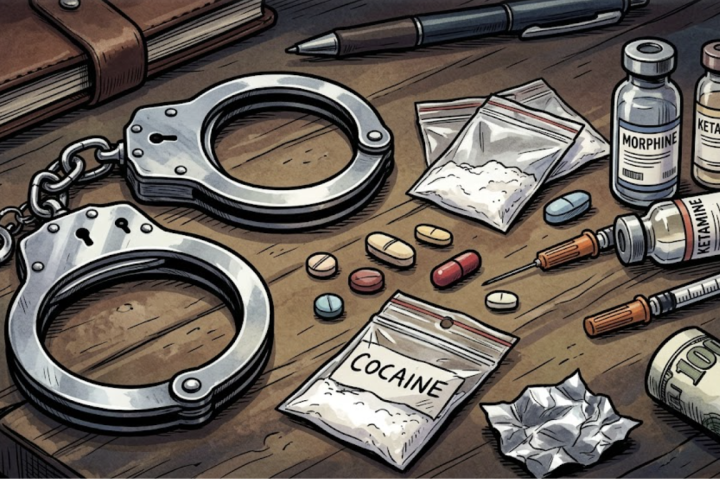
In late April, Maldives Customs intercepted 1.1 kilograms of amphetamines at Velana International Airport, a haul with an estimated street value of 3.3 million rufiyaa. The drugs had been concealed inside a sealed plastic bag packed into a box, and the case remains under investigation. It was one of several seizures this year that have underscored how the archipelago, long a transit point as well as a destination for narcotics, remains a target for traffickers operating across South Asia and beyond. A vessel seizure some years earlier intercepted 70 kilograms of narcotics believed to have originated in Pakistan, and customs has previously mapped trafficking routes reaching into more than a dozen countries – testament to how the country’s geography, scattered across a vast stretch of ocean, makes interdiction difficult.
Indian nationals have featured prominently in recent smuggling cases. Five were arrested at the airport in March, and one defendant later told the Criminal Court that he had been deceived into travelling to the Maldives, believing he had won a lottery prize, and was unaware that items he was asked to carry allegedly contained illegal drugs. India’s Narcotics Control Bureau raised concerns in April over a rising number of Indian nationals being linked to smuggling operations involving the Maldives, urging travellers not to carry items handed to them by strangers.
The legal stakes for anyone caught have risen sharply. In December 2025, the People’s Majlis passed a sweeping amendment to the Drugs Act introducing the death penalty for major drug traffickers-a change subsequently ratified by President Muizzu that took effect in March 2026. Under the new framework, capital punishment can only be carried out if the Supreme Court bench reaches a unanimous decision on the verdict. The legislation divides drugs and related items into three distinct schedules covering prohibited illicit substances, medicinal drugs, and the precursor chemicals or equipment used to manufacture them.
Homeland Security Minister Ali Ihusaan declared there would be “no mercy or exception” for traffickers, though the move has drawn criticism from some political figures, including former President Abdulla Yameen. Under the amendments, which took effect on 7 March, capital punishment for major trafficking cases requires a majority ruling from a full Supreme Court bench; absent that, the sentence reverts to life imprisonment alongside a substantial fine.
India’s High Commission has since urged its citizens to take the law seriously, warning that ignorance of local law offers no protection once an offence has been registered.
Drug abuse has been recognised as one of the Maldives’ most serious social problems for decades, and its scale has only grown. Research drawing on national statistics has estimated more than 50,000 drug-related arrests between 2016 and 2023 alone, with opiate use rising sharply over that period, while a national drug agency survey put the number of active drug users at over 7,000 – roughly double the figure recorded in 2016. Heroin and cannabis remain the substances most often seized in greater Malé, and young people aged 16 to 24 continue to be disproportionately affected. In a 2024 youth survey, more than a third of respondents named illicit drugs among the country’s three most pressing issues.
Against this backdrop, the government has been working to widen its treatment infrastructure rather than relying solely on punitive measures. Speaking on the importance of building human capacity within the recovery system, the Ministry of Homeland Security and Technology has highlighted the need to strengthen psychosocial support systems alongside new community-based treatment programmes, describing such an approach as a crucial response to the country’s wider drug crisis. The ministry stated that the government is training personnel and seeking partnerships with NGOs to deliver recovery support services, with the President having approved funding for participating organisations within the current year. The push comes as existing detoxification centres are operating at capacity, leaving people seeking treatment facing lengthening waiting periods.
Separately, the National Reintegration Centre under the Ministry of Homeland Security and Technology has been working with the UN Office on Drugs and Crime to build capacity in trauma-informed care. A two-week training programme run last October brought together eighteen participants – eleven women and seven men – from the Centre, the Ministry of Islamic Affairs and local schools to study mental health and psychosocial support techniques, psychological first aid and crisis management. The sessions combined classroom instruction with simulation exercises and peer discussion, aimed at helping participants deliver care that supports safe and dignified rehabilitation.
Tackling adequately the country’s drug problem was among the central pledges of President Muizzu’s 2023 campaign, and successive ministers have framed treatment capacity – not just enforcement – as the measure of whether that pledge is met. Whether tougher sentencing curbs the flow of narcotics into the Maldives, or whether expanded recovery and psychosocial support reduce relapse among those already affected, are likely to remain open questions for some time. What is clear is that the government is no longer treating the two efforts as separate: harsher deterrence at the border, and a broader support network for those trying to recover, are increasingly presented as two halves of the same policy.